ORIGINAL RESEARCH
Synergistic efficacy of low-intensity extracorporeal shock wave and platelet-rich plasma on erectile dysfunction
1 Nursing Department, Taipei Medical University Hospital, Taipei, Taiwan
2 Graduate Institute of Clinical Medicine, School of Medicine, College of Medicine, Taipei Medical University, Taipei, Taiwan
3 Department of Urology, Taipei Medical University Hospital, Taipei, Taiwan
4 TMU Research Center of Urology and Kidney, Taipei Medical University, Taipei, Taiwan
5 Victory Biotechnology Co., Ltd., Taipei, Taiwan
6 Executive Programme in Healthcare Management, Indian Institute of Management Lucknow, Lucknow, India
7 Baba Kinaram Autonomous State Medical College Chandauli, Uttar Pradesh, India
8 Institute of Traditional Medicine, School of Medicine, National Yang-Ming Chiao Tung University, Taipei, Taiwan
9 Department of Urology, Department of Surgery, Taipei City Hospital Ren-Ai Branch, Taipei, Taiwan
10 Institute of Microbiology and Immunology, National Yang Ming Chiao Tung University, Hsinchu, Taiwan
11 Clinical Research Center, Taipei Medical University Hospital, Taipei, Taiwan
12 School of Dental Technology, College of Oral Medicine, Taipei Medical University, Taipei, Taiwan
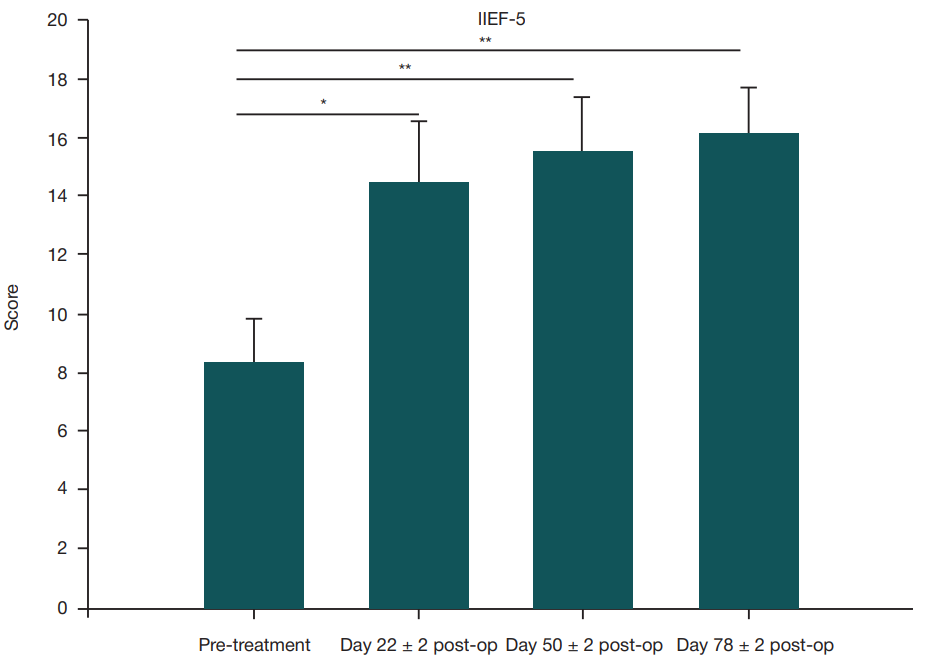
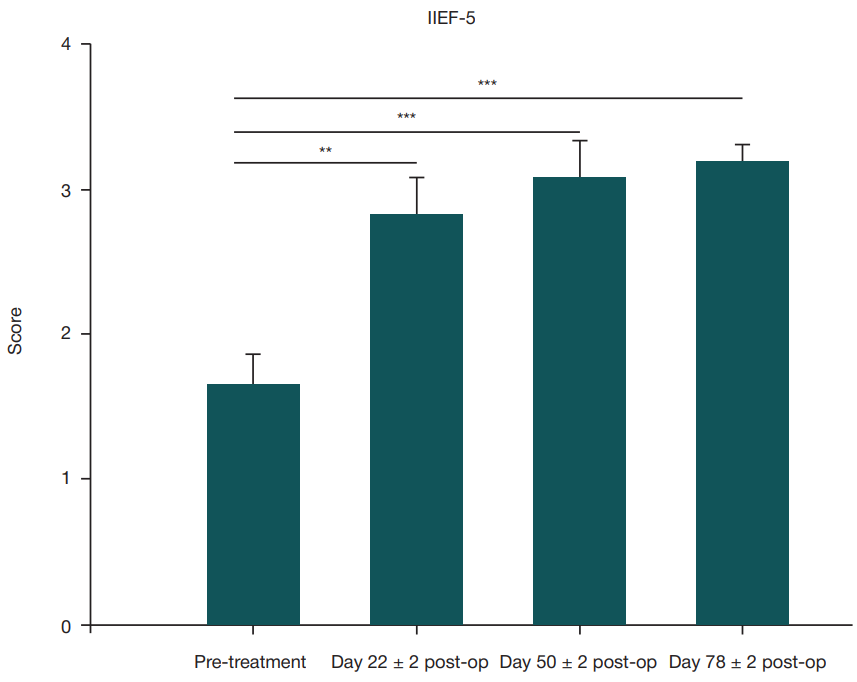
Erectile dysfunction (ED), an unusual sexual condition in which the person fails to attain or sustain an erectile penis, severely impacts personal relationships, confidence, and efficiency. To date, low-intensity extracorporeal shock wave therapy (Li-ESWT) is an option to manage ED; however, it is associated with adverse events such as bruising, redness, and pain. Hence, in this study, we applied platelet-rich plasma (PRP), a blood-derived biomaterial containing cargo of growth factors, to enhance the therapeutic efficacy of Li-ESWT on ED. We assessed the synergistic effect of PRP+Li-ESWT, in which Li-ESWT was extracorporeally applied simultaneously with PRP. They were evaluated clinically at 22 ± 2, 50 ± 2 and 78 ± 2 days. Statistical analysis was performed using a non-parametric test, Friedman repeated measures as an alternative non-parametric test of ANOVA test. The international index of erectile function (IIEF-5) and erection hardness score (EHS) were recorded. IIEF-5 score in the pre-treated group was 8.36 ± 1.44. After 22 ± 2 days of synergistic PRP+Li-ESWT treatment, the score was 14.45 ± 2.12 (p < 0.028). This score further increased to 15.45 ± 1.93 (p < 0.008) and 16.18 ± 1.48 (p < 0.001) after 50 ± 2 days and 78 ± 2 days of treatment, respectively. The mean pre-treated EHS was 1.64 ± 0.20 (p < 0.002), which increased to 2.81 ± 0.26 (p < 0.002), 3.09 ± 0.25 (p < 0.0002) and 3.18 ± 0.12 (p < 0.000) on day 22 ± 2, 50 ± 2 and 78 ± 2 days, respectively. Conclusively, our study demonstrated potent synergistic therapy of PRP+Li-ESWT in ED treatment by improving IIEF-5 and EHS scores. However, extensive mechanism-based clinical studies are needed to reach a consensus.
Keywords: erectile dysfunction, Li-ESWT, platelet-rich plasma (PRP), IIEF-5, EHS
Acknowledgements: we are grateful to TCM Biotech International Corp., New Taipei City, Taiwan to provide VertePLT Plus Platelet Concentrate Separator (VertePLT) to prepare PRP for therapeutic application in ED patients.
Author contribution: Lee YC, Yang TD — Idea of the study, methodology, data analysis, investigation, validation, Writing-original draft (# Equal first authors); Chen WC, Dubey NK, Chaturvedi H, Huang AC, Chang CH, Lin CC — data analysis, investigation, validation; Liu MC — data analysis, investigation, validation, Writing-Review and Editing, Supervision.
Compliance with ethical standards: this study was approved by Taipei Medical University-Joint Institutional Review Board (IRB No. N201907013) and Taiwan FDA (TFDA: Case No. 1086614281) and registered at ClinicalTrials.gov (accessed on 04 June 2020) (NCT04416802). A written informed consent was obtained from the subjects enrolled.
Correspondence should be addressed: Ming-Che Liu
Taipei, Taiwan 11031; wt.ude.umt@200790402d
Erectile dysfunction (ED) is an unusual sexual condition in which the person fails to attain or sustain an erectile penis [1]. It could severely affect sexual health and activity, which negatively impacts personal relationships, psychological status, and quality of life [1, 2]. Penile erection is regulated by oxygen tension, and its lower levels decrease cavernous trabecular smooth muscle content, resulting in venous leakage, oxidative stress, inflammation, structural change in the penile interstitium and neural structures due to vasoconstriction, endothelial dysfunction, veno-occlusive disease, and in the long-term may cause initiation and progression of ED [3].
It has been projected that the incidence of ED may influence the population of 322 million by 2025 [1, 4]. Recent longitudinal epidemiological data suggest that the prevalence of ED could range from 32–80%, depending on the age [5]. As the age increases, the risk and incidence of ED also elevate, particularly in the age group of 40–70 years [5]. To date, though various traditional ED therapies, including pharmaceutical and surgical alternatives, have been employed, the results either demonstrated an inadequate efficacy or adverse events. Hence, a complete therapeutic solution is urgently needed.
Low-intensity extracorporeal shockwave therapy (Li-ESWT) is a therapeutic approach that has the potential to regenerate endothelium, smooth muscle cells, and neuronal nitric oxide synthase-positive nerves [6]. Shock waves are acoustic waves with a frequency range of 16–20 MHz with a period of up to 10 microseconds and are collected in the focal zone, which could be a targeted tissue or organ for therapeutic purposes [7]. Low-intensity shockwaves are low-energy waves of less than 0.1mJ/mm2 energy flux density (EFD), though no consensus has yet been reached on the EFD range [8]. Additional changes include the proliferation of T cells, recruitment of stem cells, increase in endothelial capillary connections, regeneration of nerve and axonal cells, collagen matrix alteration, and decrease in inflammation and oxidative stress [9].
PRP is a blood-derived product rich in growth factors such as vascular endothelial growth factor (VEGF), basic fibroblast growth factor (bFGF), transforming growth factor β-1 (TGF-β1), platelet-derived growth factors (PDGF), hepatocyte growth factor (HGF), insulin-like growth factor-1 (IGF-1), epidermal growth factor (EGF), and various cytokines. These factors participate in tissue growth and healing through activation and the proliferation of fibroblasts, smooth muscle cells, and neutrophils, in addition to mesenchymal stem cell differentiation [1, 10]. PRP also contains biomolecules such as adenosine triphosphate, adenosine diphosphate, dopamine, serotonin, histamine, and Ca+2 ions, which play a crucial role in tissue homeostasis [11]. Based on the above-mentioned therapeutic activities, the potential of PRP is being explored in ED treatment. However, a few studies have suggested that PRP therapeutic efficacy could be enhanced by supplementing other alternative therapies, such as low-intensity extracorporeal shockwave therapy (Li-ESWT). Moreover, pre-clinical and clinical studies limit their wide therapeutic applications in ED. Therefore, we examined the synergistic impact of PRP and Li-ESWT-based regenerative treatment for ED.
METHODS
Patients
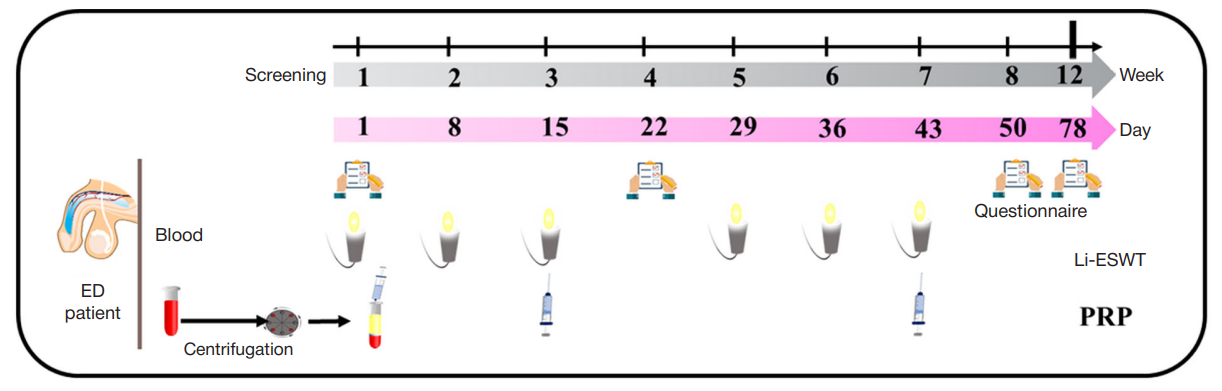
Between 20 May 2020 and 22 Feb 2022, 11 ED patients underwent a combination therapy of Li-ESWT and PRP for 78 ± 2 days. All patients were informed in detail about the synergistic treatment of Li-ESWT and PRP, as illustrated in the schematic design of the study (fig. 1).
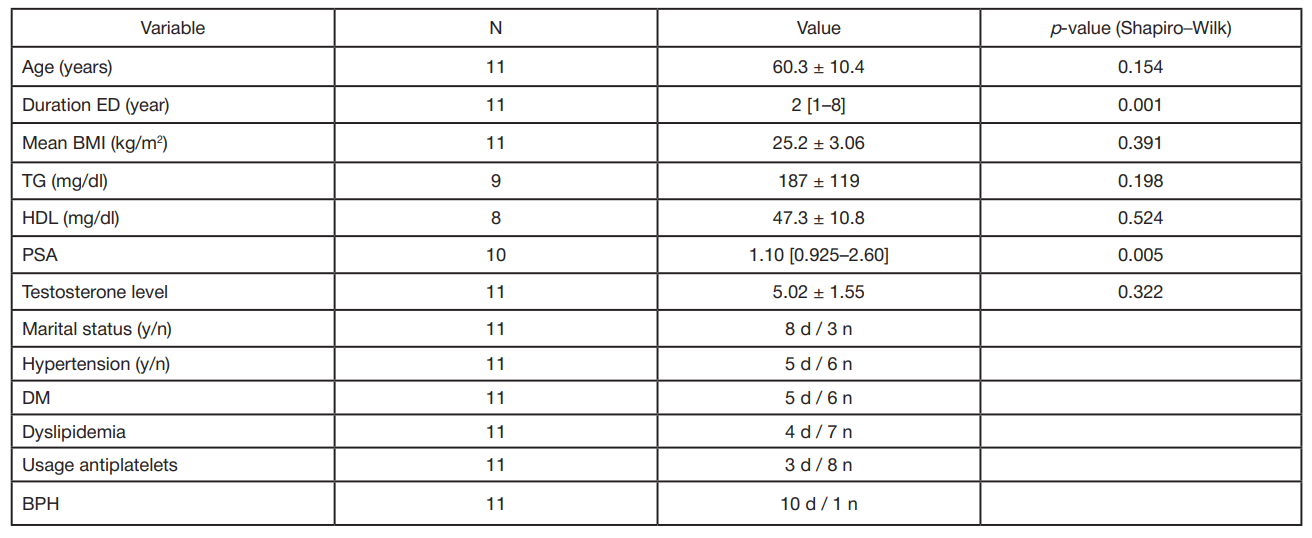
The patients’ demographic characteristics such as age, material status, ED duration, mean body mass index (BMI), triglyceride level, high-density lipoprotein (HDL), prostate serum antigen (PSA), and testosterone levels were evaluated. Additionally, hypertension, diabetes mellitus (DM), BPH, dyslipidemia, and antiplatelet therapy use were also recorded.
Inclusion and exclusion criteria
This study included patients suffering from impotence for more than 3 months, with an international index of erectile function (IIEF) less or equal to 21, erectile hardness score (EHS) of 0, ≤ 3, and age over 30 years old. Whereas the patients were excluded if they patients have characteristics such as hypogonadism, bleeding tendency, could not cooperate with the treatment, AIDS, syphilis, condyloma victim, received radical prostatectomy, prostate cancer or pelvis malignant tumor victim, gonad dysfunction, penis deformities, penile prosthesis implantation, psychiatric disease victim, neural disease (multiple myeloma, brain atrophy, etc.), pacemaker implantation, not suitable to join this trial judged by the investigation, alcohol or drug abuse.
Li-ESWT application
Treatment of Li-ESWT using PiezoWave 2 (Richard Wolf GmbH, Knittlingen, Germany) machine was performed on days 1, 8, 15, 29, 36, and 43. In each treatment, 2,000 shockwaves (SW) (0.16 mJ/ mm2, 6–8 hertz (Hz) were applied to the penile shafts and 2,000 SW to the perineal corpus cavernosum.
Preparation and injection of human platelet-rich plasma (PRP)
To prepare PRP, we employed a specialized platelet concentrate separator containing ACD-A as an anticoagulant and a specific separator gel to harvest platelets and plasma to prevent contamination from other blood components, including red blood cells and leukocytes. In brief, we collected 7 milliliters (mL) of autologous human peripheral blood into a PLTenus PLUS Platelet Concentrate Separator (TCM Biotech International Corp., Taipei, Taiwan) through a sterile venipuncture. Then, the collected blood was centrifuged at 500~1200G for 8 minutes. Thereafter, approximately 4 mL of mixed plasma and platelets, which remained over the thixotropic gel layer, were isolated and then collected in a falcon tube for therapeutic application. The 0.5 ml PRP was then injected intracorporeally at 6 sites on the penile shaft, and the therapeutic efficacy was evaluated using IIEF-5 and EHS scores.
Outcome measurements
We evaluated treatment outcomes using the IIEF-5 and EHS scores. IIEF-5 is a self-assessment score-based questionnaire to determine the erectile function and severity of ED [12]. It specifically employs five domains to measure erectile function, sexual desire, orgasmic function, intercourse satisfaction, and overall satisfaction. Erection hardness is assessed through EHS, a four-point scale self-report based on a single item [13]. This reliable score system also indicates a direct relation between erection hardness and intercourse. Pre-treatment scores were compared with post-treatment scores to assess the efficacy of this synergistic treatment. The post-treatment scores were measured at 22 ± 2 and 50 ± 2 days and 78 ± 2 days.
Statistical analysis
The statistical analysis was performed using non-parametric test, Friedman repeated measures as an alternative nonparametric test of ANOVA test, which is suitable for non-normal distribution data/small sample. Further, pairwise comparison by Durbin-Conovar tests was done as post-hoc test (alternative non-parametric test of student t-test). The values were considered significant only when less than 0.05.
RESULTS
Demographics of patients
The study involved 11 patients treated with a combination of Li-ESWT and PRP. As shown in tab. 1, no significant difference was observed for the age, BMI, TG, HDL, PSA, and testosterone; however, ED duration was significant. Out of 11 patients, 8 (72.73%) were married, and 5 (45.46%) suffered from hypertension and DM. Three patients (27.27%) had been using antiplatelets. After the treatment, the IIEF-5 and EHS scores were assessed.
Effect of PRP+Li-ESWT on IIEF-5 scores
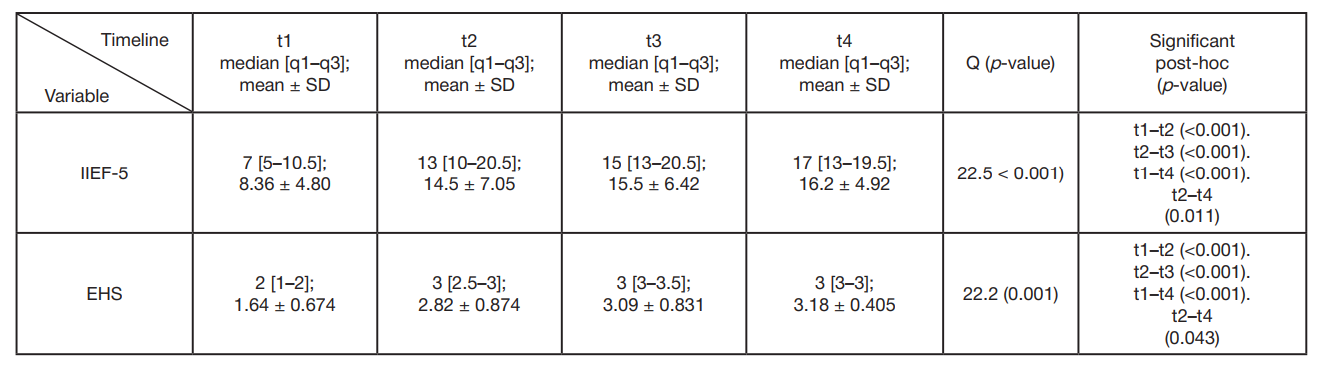
The median [q1–q3] and mean±SD value of IIEF-5 (fig. 2) at different time points are shown in tab. 2 for the two groups (pre-treatement and PRP+Li-ESWT treatment). In the PRP+LiESWT group, the median [q1–q3] IIEF-5 scores significantly increased during t1–t2, t1–t3 and t1–t4 (p < 0.001).
Impact of PRP+Li-ESWT on erection hardness
Further, erection hardness score (EHS) (fig. 3) also showed similar pattern the median [q1–q3] values significantly during t1–t2, t1–t3 and t1–t4 (p < 0.001), indicating the efficacy of PRP+Li-ESWT in gaining erection hardness, which is a fundamental component of erectile function.
DISCUSSION
Li-ESWT is considered a safer alternative in ED treatment, especially in the case of mild vasculogenic ED or when patients are less responsive to PDE-5i [6]. It promotes neo-angiogenesis, improves blood circulation in cavernosal tissues, and suppresses inflammation and stress [14]. In DM patients, Li-ESWT mimics shear stress, affects membrane permeabilization, and regulates signal cascades, resulting in an inhibited inflammatory response, secretion of nitric oxide, mobilization of endothelial and stem cells, and improved nNOS-positive nerves in corpora cavernosa and endothelial content in cavernous arteries and sinusoids [15]. Based on this evidence, we anticipate that all the therapeutic impacts, particularly neovascularization, could be elevated through supplementing PRP.
PRP is rich in trophic growth factors and regenerative molecules, which may promote stem cell recruitment, angiogenesis, nitric oxide synthesis, and cavernosal nerve regeneration. In the murine model, PRP has been demonstrated with neuroprotective and neuro-regenerative effects by lowering the expression of caspase-3 and TGF-β1, resulting in PDGF levels [16]. The PRP-contained VEGF and BDNF promote nerve regeneration, upregulation of nNOS, and axon growth [17]. Li-ESWT also induces the expression of VEGF and its receptor Flt-1(vascular endothelial growth factor receptor-1)[18], which could be further accelerated through PRP-contained VEGF. In addition, BDNF activates the Janus kinase signal transducer and activator of the transcription (JAK-STAT) pathway, which promotes neurite growth in the pelvic ganglion region [17, 19]. The BDNF, IGF-1, VEGF, and bFGF present in PRP have effectively restored penile hemodynamics in the pre-clinical models [20].
In our study, some of the patients showed characteristics of hypertension, diabetes, and high triglyceride levels (tab. 1). It has been evident that 25% and 60% of patients treated for hypertension and diabetes, respectively, suffered from ED [21]. Aging reduces the level of testosterone, smooth muscle cells in the penis, and elastic fibers in tunica albuginea, which results in ED [22]. Endothelial dysfunction due to dyslipidemia is a prominent cause of ED [23]. It has been further observed that ED is associated with at least one of the co-morbidities such as depression (11.1%), DM (20.2%), hyperlipidemia (42.4%), and hypertension (41.6%). Thus, the presence of above-mentioned characteristics/demographics in our patients is associated with ED.
Our study combined both Li-ESWT and PRP therapies to evaluate the synergistic effect of the combination therapy. The therapeutic outcomes, i.e., erectile function and hardness, were assessed using IIEF-5 and EHS scores, respectively (tab. 2). The median changes in IIEF-5 score using Li-ESWT among ED patients are +3.5 (p = 0.0049) and +1 (p = 0.046) after 1 month and 1 year post-treatment [24]. Li-ESWT improved the baseline IIEF-5 score from 8.27±2.741 to 10.43 ± 8.43 after one month of the treatment, and the therapeutic effect was sustained for 6 months at a similar level [25]. Another randomized clinical study indicates that weekly Li-ESWT treatment for five weeks of courses improves EHS and IIEF-5 scores. The EHS score increases by 0.35 and 0.50, whereas the IIEF-5 score improves by 2.40 and 3.45 after 4 and 12 weeks of treatment [26]. A 14-week Li-ESWT treatment (once a week), which includes a gap of 4 weeks after 5 weeks, reported improvement in IIEF-EF score from baseline 11.5 to 13 and 12.6 after 5 and 10 sessions, respectively [27]. The above-mentioned studies showed an improvement in IIEF-5 and EHS in the range of 2–5 and 0.3–2 points, respectively. However, our study has recorded an increment of 6-8 points in the mean baseline IIEF-5 score of 8.36 ± 1.44, which was significantly elevated to 14.45 ± 2.12, 15.45 ± 1.93, and 16.18 ±1.48 after 22 ± 2, 50 ± 2 and 78 ± 2 days post-treatment, respectively. Similarly, the mean EHS baseline score of 1.64 ± 0.20 increased to 2.81 ± 0.26, 3.09 ± 0.25, and 3.18 ± 0.12 at 22 ± 2, 50 ± 2, and 78 ± 2 days post-treatment, respectively. This data indicates improvement in erectile function in our combined treatment of Li-ESWT+PRP, which is comparatively better than previously reported monotherapy of Li-ESWT.
The enhanced therapeutic impact may be attributed to PRP, which promotes natural healing. The IIEF score is improved without adverse events when used to treat ED [28]. A prospective study showed the significant efficacy of PRP in improving IIEF score after treatment (p = 0.02)[1]. However, a fibrotic plaque develops on the ventral side in the middle of the penile shaft. However, intravaginal ejaculatory latency time significantly improved due to the combination treatment. The regenerative therapeutic efficacy of PRP has been widely evaluated among various disorders and is linked to the growth factor and other bioactive molecules present in the PRP. VEGF, a PRP component, has shown that it could effectively recover erectile function among CN injury animal models [29]. In coherence, a double-blinded, randomized, placebo-controlled clinical trial evidenced that PRP significantly attained minimal clinically important difference (MCID) in the IIEF-EF (erectile domain) post 6 months of treatment [30]. Moreover, the satisfaction level was evident without any hemorrhagic adverse events.
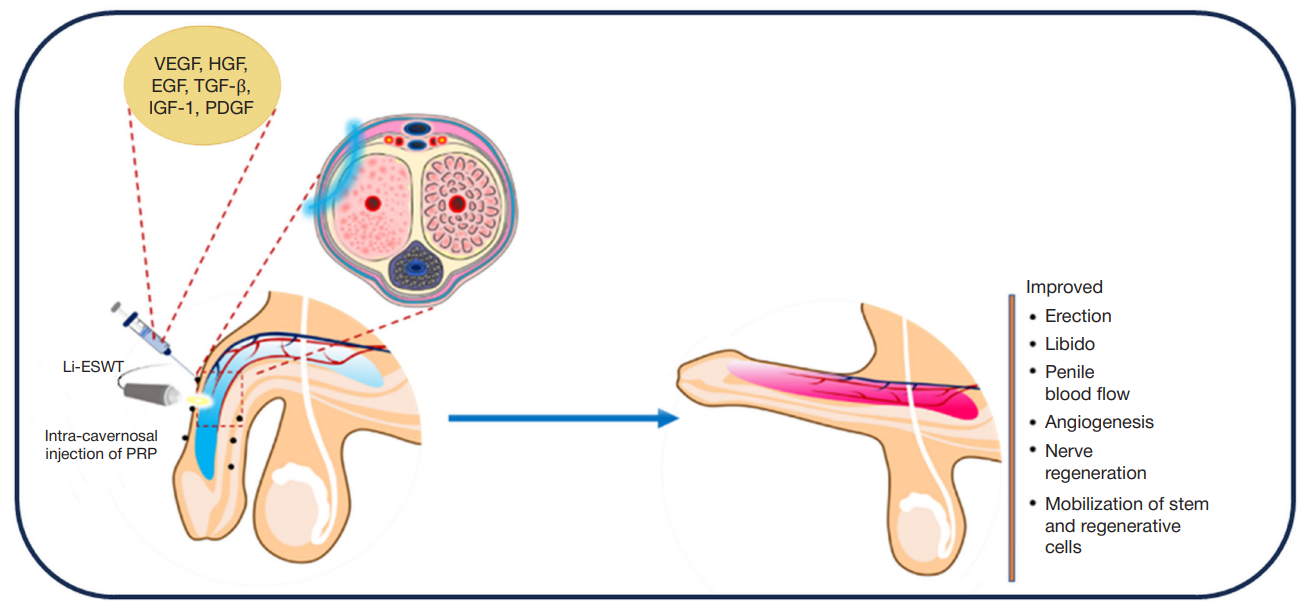
It has been demonstrated that PRP improves erectile function among diabetic rat models by inhibiting the atrophy of corporal smooth muscle cells, corpus cavernosum safety, and regenerating CN fiber [16]. In addition, PRP also restores tissue and improves all parameters of erectile function and myelinated nerve regeneration among DM rats [16]. Thus, PRP could effectively minimize post-surgical complications due to DM in ED treatment. Similarly, the PRP treatment significantly improves intracavernous pressure, mean arterial pressure, IGF-1, BDNF, and VEGF levels among hyperlipidemia-associated ED rats [31]. Moreover, the PRP treatment also improves endothelial cells, neuronal nitric oxide synthase, and endothelial nitric oxide synthase in the corporal tissues, resulting in lower oxidative stress and apoptotic index. Based on our results, we infer that PRP could improve the Li-ESWT-treated ED owing to its wound-healing potential for microtrauma developed during Li-ESWT (fig. 4).
Limitations of the study
Apart from various positive therapeutic outcomes, our study includes limitations like the lack of a control group such as Li-ESWT, which will be investigated in the future. However, a previous study on monotherapy of Li-ESWT [32] demonstrated an effective and safer profile for diabetic as well as non-diabetic ED patients. Hence, combined Li-ESWT and PRP treatment is anticipated to offer an enhanced therapeutic efficacy on ED. The pain score while injecting PRP was not recorded, which will also be the focus of our future study. Small sample size is another limitation of the study; however, we have conducted statistical analysis using non-parametric test, Friedman repeated measures as alternative non-parametric test of ANOVA test, which is suitable for nonnormal distribution data/small sample. We further did pairwise comparison by Durbin-Conovar tests as post-hoc test (alternative non-parametric test of student t-test). Notwithstanding, replicating the study with a larger population is recommended. Age is also a significant factor in maintaining healthy sexual activity. As per epidemiological evidence, the prevalence of moderate to complete erectile dysfunction (ED) increases with age, and the data indicates that in men, ED prevalence is 5.1%, 14.8% and 44% in men aged 29–30, 40–59, and 60–69, respectively [33]. Additionally, over 50% of men aged 70 and above are diagnosed with ED. Therefore, we did not specify the maximum age; however, our sample population showed the maximum age of 70–71, which coincides with the previous studies.
CONCLUSIONS
Our study demonstrates the synergistic potential of PRP and Li-ESWT in treating ED through enhancing IIIEF-5 and EHS. However, PRP's augmentative impact on Li-ESWT should be corroborated through extensive multi-center clinical trials. Further, due to a lack of established protocols, more efforts are needed to develop an effective regenerative treatment procedure to achieve the highest clinical benefits.
- Taş T, Çakıroğlu B, Arda E, Onuk Ö, Nuhoğlu B. Early Clinical Results of the Tolerability, Safety, and Efficacy of Autologous Platelet-Rich Plasma Administration in Erectile Dysfunction. Sex Med. 2021; 9: 100313.
- Vance G, Zeigler-Hill V, Shackelford TK. Erectile Dysfunction and Sexual Coercion: The Role of Sperm Competition Risk. Archives of Sexual Behavior. 2022; 51 (6): 2781–90.
- Trebatický B, Žitňanová I, Dvořáková M, Országhová Z, Paduchová Z, Ďuračková Z, et al. Role of oxidative stress, adiponectin and endoglin in the pathophysiology of erectile dysfunction in diabetic and non-diabetic men. Physiol Res. 2019; 68: 623–31.
- Ayta I, McKinlay J, Krane R. The likely worldwide increase in erectile dysfunction between 1995 and 2025 and some possible policy consequences. BJU international. 1999; 84: 50–56.
- Colson MH, Cuzin B, Faix A, Grellet L, Huyghes E. Current epidemiology of erectile dysfunction, an update. Sexologies, 2018; 27: e7–e13.
- Geyik S. Comparison of the efficacy of low-intensity shock wave therapy and its combination with platelet-rich plasma in patients with erectile dysfunction. Andrologia. 2021; 53: e14197.
- Lei H, Liu J, Li H, Wang L, Xu Y, Tian W, et al. Low-Intensity Shock Wave Therapy and Its Application to Erectile Dysfunction. wjmh, 2013; 31: 208–14.
- Liu J, Zhou F, Li G-Y, Wang L, Li H-X, Bai G-Y, et al. Evaluation of the Effect of Different Doses of Low Energy Shock Wave Therapy on the Erectile Function of Streptozotocin (STZ)-Induced Diabetic Rats. International Journal of Molecular Sciences. 2013; 14: 10661–73.
- Sun D, Junger WG, Yuan C, Zhang W, Bao Y, Qin D, et al. Shockwaves Induce Osteogenic Differentiation of Human Mesenchymal Stem Cells Through ATP Release and Activation of P2X7 Receptors. Stem Cells; 2013; 31: 1170–80.
- Mijiritsky E, Assaf HD, Peleg O, Shacham M, Cerroni L, Mangani L. Use of PRP, PRF and CGF in Periodontal Regeneration and Facial Rejuvenation-A Narrative Review. Biology. 2021; 10: 317.
- Bos-Mikich A, de Oliveira R, Frantz N. Platelet-rich plasma therapy and reproductive medicine. Journal of Assisted Reproduction and Genetics. 2018; 35: 753–6.
- Mark KP, Arenella K, Girard A, Herbenick D, Fu J, Coleman E. Erectile dysfunction prevalence in the United States: report from the 2021 National Survey of Sexual Wellbeing. J Sex Med. 2024; 21: 296–303.
- Mulhall JP, Goldstein I, Bushmakin AG, Cappelleri JC, Hvidsten K. Validation of the Erection Hardness Score. The Journal of Sexual Medicine. 2007; 4: 1626–34.
- Sokolakis I, Dimitriadis F, Teo P, Hatzichristodoulou G, Hatzichristou D, Giuliano F. The Basic Science Behind Low-Intensity Extracorporeal Shockwave Therapy for Erectile Dysfunction: A Systematic Scoping Review of Pre-Clinical Studies. J Sex Med. 2019; 16: 168–94.
- Spivak L, Shultz T, Appel B, Verze P, Yagudaev D, Vinarov A. Low-Intensity Extracorporeal Shockwave Therapy for Erectile Dysfunction in Diabetic Patients. Sex Med Rev. 2021; 9: 619–27.
- Liao C-H, Lee K-H, Chung S-D, Chen K-C, Praveen Rajneesh C, Chen B-H, et al. Intracavernous Injection of Platelet-Rich Plasma Therapy Enhances Erectile Function and Decreases the Mortality Rate in Streptozotocin-Induced Diabetic Rats. International journal of molecular sciences. 2022; 23: 3017.
- Ding X-G, Li S-W, Zheng X-M, Hu L-Q, Hu W-L, Luo Y. The effect of platelet-rich plasma on cavernous nerve regeneration in a rat model. Asian journal of andrology. 2009; 11: 215–21.
- Vardi Y, Appel B, Jacob G, Massarwi O, Gruenwald I. Can low-intensity extracorporeal shockwave therapy improve erectile function? A 6-month follow-up pilot study in patients with organic erectile dysfunction. Eur Urol. 2010; 58: 243–8.
- Bella AJ, Lin G, Tantiwongse K, Garcia M, Lin CS, Brant W, et al. Brain–derived neurotrophic factor (BDNF) acts primarily via the JAK/STAT pathway to promote neurite growth in the major pelvic ganglion of the rat: Part I. The journal of sexual medicine. 2006; 3: 815–20.
- Huang Y-C, Wu C-T, Chen M-F, Kuo Y-H, Li J-M, Shi C-S. Intracavernous Injection of Autologous Platelet-Rich Plasma Ameliorates Hyperlipidemia-Associated Erectile Dysfunction in a Rat Model. Sexual Medicine. 2021; 9: 100317.
- Hafez ES, Hafez SD. Erectile dysfunction: anatomical parameters, etiology, diagnosis, and therapy. Arch Androl. 2005; 51: 15–31.
- Seftel AD. Erectile dysfunction in the elderly: epidemiology, etiology and approaches to treatment. J Urol. 2003; 169: 1999–2007.
- Miner M, Billups KL. Erectile Dysfunction and Dyslipidemia: Relevance and Role of Phosphodiesterase Type-5 Inhibitors and Statins. The Journal of Sexual Medicine. 2008; 5: 1066–78.
- Frey A, Sønksen J, Fode M. Low-intensity extracorporeal shockwave therapy in the treatment of postprostatectomy erectile dysfunction: a pilot study. Scand J Urol. 2016; 50: 123–7.
- Akande TO, Akinwunmi OM, Adebayo SA, Akinyinka AO, Shittu OB. Efficacy and safety of low-intensity extracorporeal shockwave therapy for treatment of vascular erectile dysfunction in nigerian men: Report of a study in Ibadan, South-West Nigeria. Ann Ib Postgrad Med. 2021; 19: 8–14.
- Ladegaard PBJ, Mortensen J, Skov-Jeppesen SM, Lund L. Erectile Dysfunction A Prospective Randomized Placebo-Controlled Study Evaluating the Effect of Low-Intensity Extracorporeal Shockwave Therapy (LI-ESWT) in Men With Erectile Dysfunction Following Radical Prostatectomy. Sex Med. 2021; 9: 100338.
- Fojecki GL, Tiessen S, Osther PJS. Effect of Low-Energy Linear Shockwave Therapy on Erectile Dysfunction—A DoubleBlinded, Sham-Controlled, Randomized Clinical Trial. The Journal of Sexual Medicine. 2017; 14: 106–12.
- Banno JJ, Kinnick TR, Roy L, Perito P, Antonini G, Banno D. 146 The Efficacy of Platelet-Rich Plasma (PRP) as a Supplemental Therapy for the Treatment of Erectile Dysfunction (ED): Initial Outcomes. The Journal of Sexual Medicine. 2017; 14: e59–e60.
- Chen KC, Minor TX, Rahman NU, Ho HC, Nunes L, Lue TF. The additive erectile recovery effect of brain–derived neurotrophic factor combined with vascular endothelial growth factor in a rat model of neurogenic impotence. BJU international. 2005; 95: 1077–80.
- Poulios E, Mykoniatis I, Pyrgidis N, Zilotis F, Kapoteli P, Kotsiris D, et al. Platelet-Rich Plasma (PRP) Improves Erectile Function: A Double-Blind, Randomized, Placebo-Controlled Clinical Trial. The Journal of Sexual Medicine. 2021; 18: 926–35.
- Huang Y-C, Wu C-T, Chen M-F, Kuo Y-H, Li J-M, Shi C-S. Intracavernous Injection of Autologous Platelet-Rich Plasma Ameliorates Hyperlipidemia-Associated Erectile Dysfunction in a Rat Model. Sexual medicine. 2021; 9: 100317.
- Geyik S. A single-centre result of two courses of low-intensity shockwave therapy (Li-SWT) in erectile dysfunction. Andrologia. 2022; 54: e14324.
- Pang K, Pan D, Xu H, Ma Y, Wang J, Xu P, et al. Advances in physical diagnosis and treatment of male erectile dysfunction. Front Physiol. 2022; 13: 1096741.