Copyright: © 2025 by the authors. Licensee: Pirogov University.
This article is an open access article distributed under the terms and conditions of the Creative Commons Attribution license (CC BY).

ORIGINAL RESEARCH

Pipelle and endobrush catheters do not prevent contamination of endometrial samples by cervical microbiota

Zornikov DL1 , Bekhter AA1 , Kornilov DO1 , Simarzina VM1 , Nechaeva DM1 , Karyakina AE1 , Leshukova MA1 , Amineva PG1,3 , Voroshilina ES1,2
About authors

1 Ural State Medical University, Yekaterinburg, Russia

2 Medical Center “Garmonia”, Yekaterinburg, Russia

3 LLC “Quality Med”, Yekaterinburg, Russia

Correspondence should be addressed: Danila L. Zornikov
Kluchevskaya, 17, Yekaterinburg, Russia, 620109; moc.liamg@ldvokinroz

About paper

Author contribution: Zornikov DL — study organization, data analysis, statistical analysis, writing and editing of the article; Bekhter AA — development and creation of in vitro cervical models; Kornilov DO — development and creation of in vitro cervical models, preparation of illustrations; Simarzina VM — execution of experimental work (sampling from models), manuscript preparation; Nechaeva DM — execution of experimental work (sampling from models), performance of molecular genetic studies (PCR), manuscript preparation; Karyakina AE — performance of molecular genetic studies (PCR), preparation of the manuscript and illustrations; Leshukova MA — manuscript preparation; Amineva PG — preparation and provision of bacterial cultures for analysis; Voroshilina ES — scientific supervision and coordination, analysis and interpretation of data, writing and editing of the article.

Compliance with ethical standards: the study was approved by the Ethics Committee of Ural State Medical University (Protocol № 3 dated June 20, 2025).
Received: 2025-11-18 Accepted: 2025-12-05 Published online: 2025-12-13
|
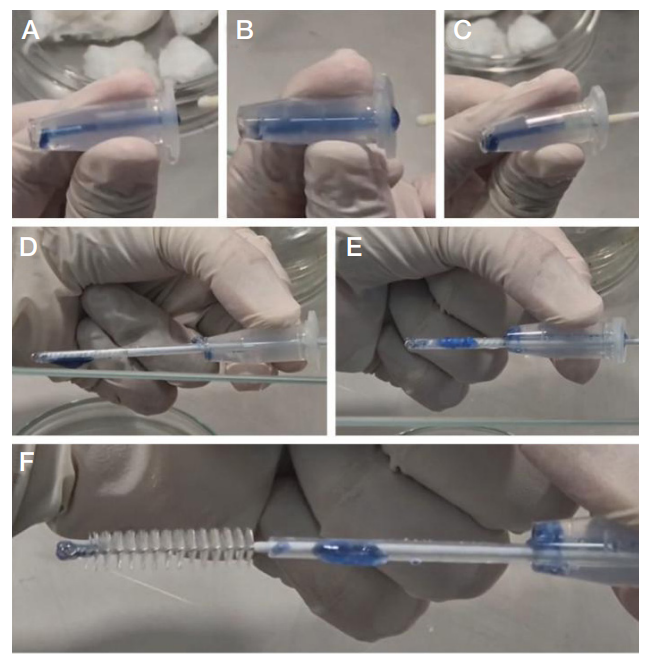
Fig. 1. Anatomical cervical models with canals filled with synthetic gelatin-alginate mucus. For better visualization, the mucus is stained with an aqueous methylene blue solution. A. Model with a cylindrical canal. B. Model with a slit-like canal. C. Sample collection from the cervical canal using a universal A2 catheter. D. ‘Successful’ exit of the Endobrush catheter beyond the cervical canal; the catheter is in the closed position, with minimal mucus on the protective sheath. E. ‘Unsuccessful’ exit of the Endobrush catheter beyond the cervical canal; the catheter is in the closed position, with abundant mucus on the protective sheath. F. Transfer of cervical mucus onto the brush of the catheter from the previous panel after the brush was extended
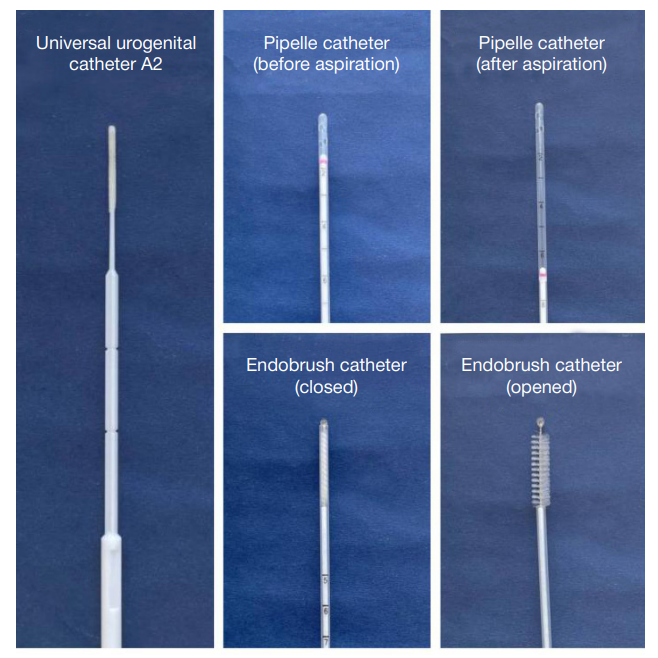
Fig. 2. Catheters used for biomaterial collection. Universal urogenital catheter type A2 for collecting model mucus from the cervical canal. Pipelle and Endobrush catheters used for sampling from the uterine cavity. The Pipelle and Endobrush catheters are shown in two states: before passing through the cervical canal (central panel) and after passing through the cervical canal — at the moment of biomaterial collection from the uterine cavity (right panel)
Table 1. Microbial composition of cervical mucus after collection with universal urogenital catheter A2 in models with cylindrical and slit-like canals. Amount of microbial DNA in GE/sample (median, Q1 –Q3)
Table 2. Microbial composition of cervical mucus in models used for evaluation of Pipelle and Endobrush catheter efficacy. Amount of microbial DNA in GE/sample (median, Q1–Q3)
Table 3. Efficacy of Pipelle and Endobrush catheters in preventing contamination by microorganisms of cervical mucus. Contamination level, % DNA transfer from cervical mucus (median, Q1–Q3)
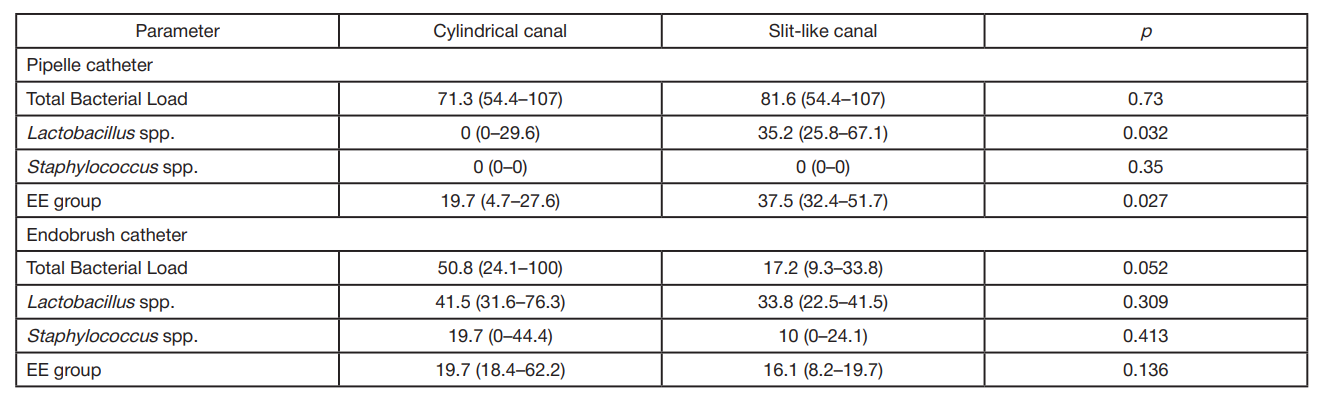
Table 4. Efficacy of Pipelle and Endobrush catheters depending on cervical canal shape. Contamination level, % DNA transfer from cervical mucus (median, Q1–Q3)