
Copyright: © 2025 by the authors. Licensee: Pirogov University.
This article is an open access article distributed under the terms and conditions of the Creative Commons Attribution license (CC BY).

OPINION

Follicular T cells in peripheral blood: increasing complexity and key questions

About authors

The Russian National Research Medical University named after N.I.Pirogov, Moscow

Correspondence: Irina L. Grigorova
Ostrovityanova, 1, Moscow, 117997, Russia; moc.liamg@67girg

About paper

Funding: this research was supported by the Russian Science Foundation (Grant No. 24-15-00545).

Acknowledgments: the author is grateful to I. V. Zvyagin for assistance with editing the article.
Received: 2025-12-10 Accepted: 2025-12-12 Published online: 2025-12-23
|
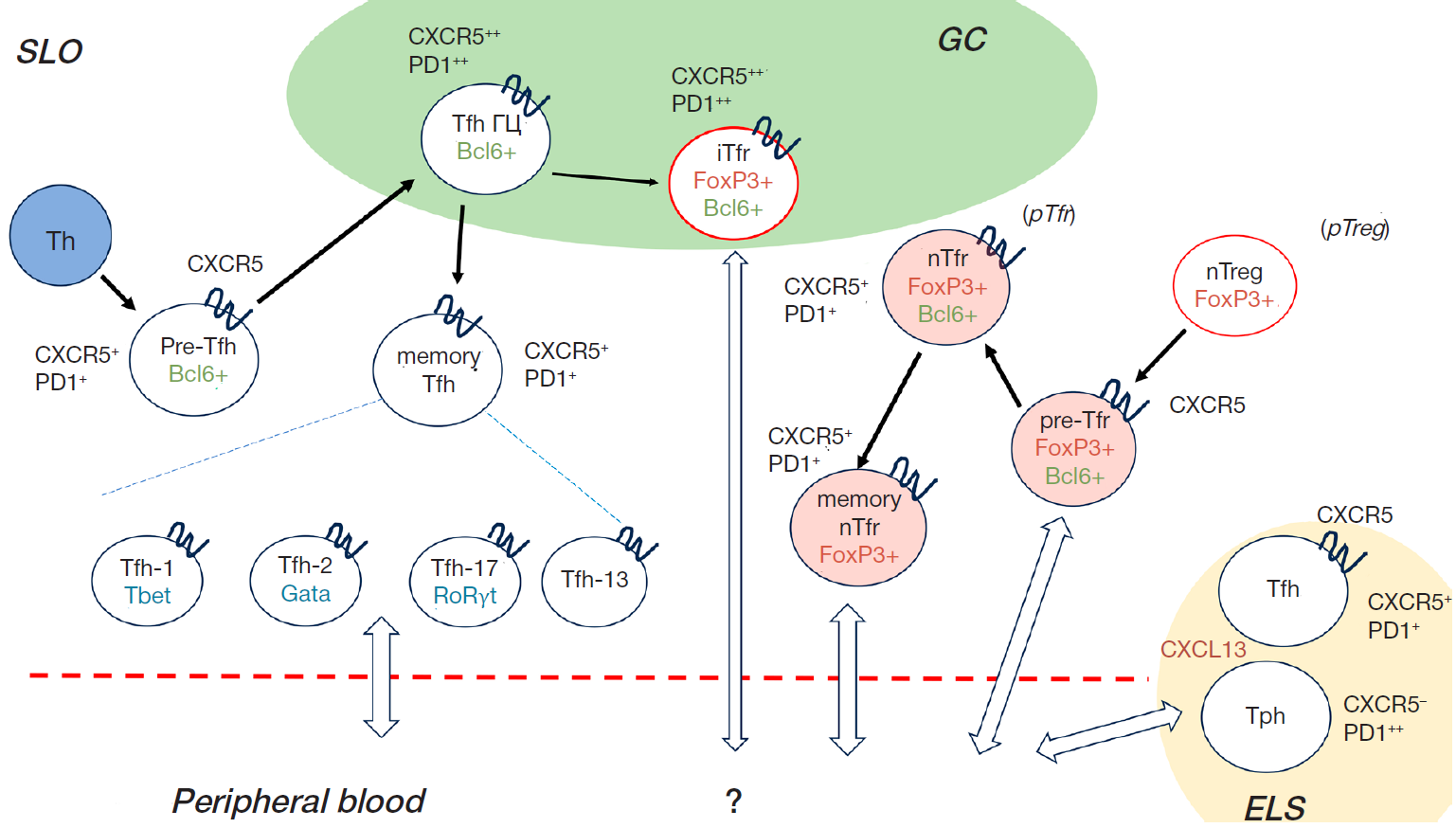
Fig. Major follicular and follicular-like T cells in humans. A schematic describing the generation in secondary lymphoid organs (SLOs) and possible recirculation into peripheral blood of the main follicular T cell subpopulations: helper (Tfh) and regulatory (Tfr). GC — germinal centers. ELS — ectopic lymphoid structures. Memory follicular T cells that acquire the ability to enter the circulation downregulate Bcl6 expression and surface levels of CXCR5 and PD1 compared to T cells in GCs. Peripheral helper T cells (Tph) and, to some extent, Tfh accumulate in ELS, where they produce the chemokine CXCL13, which can recruit B cells
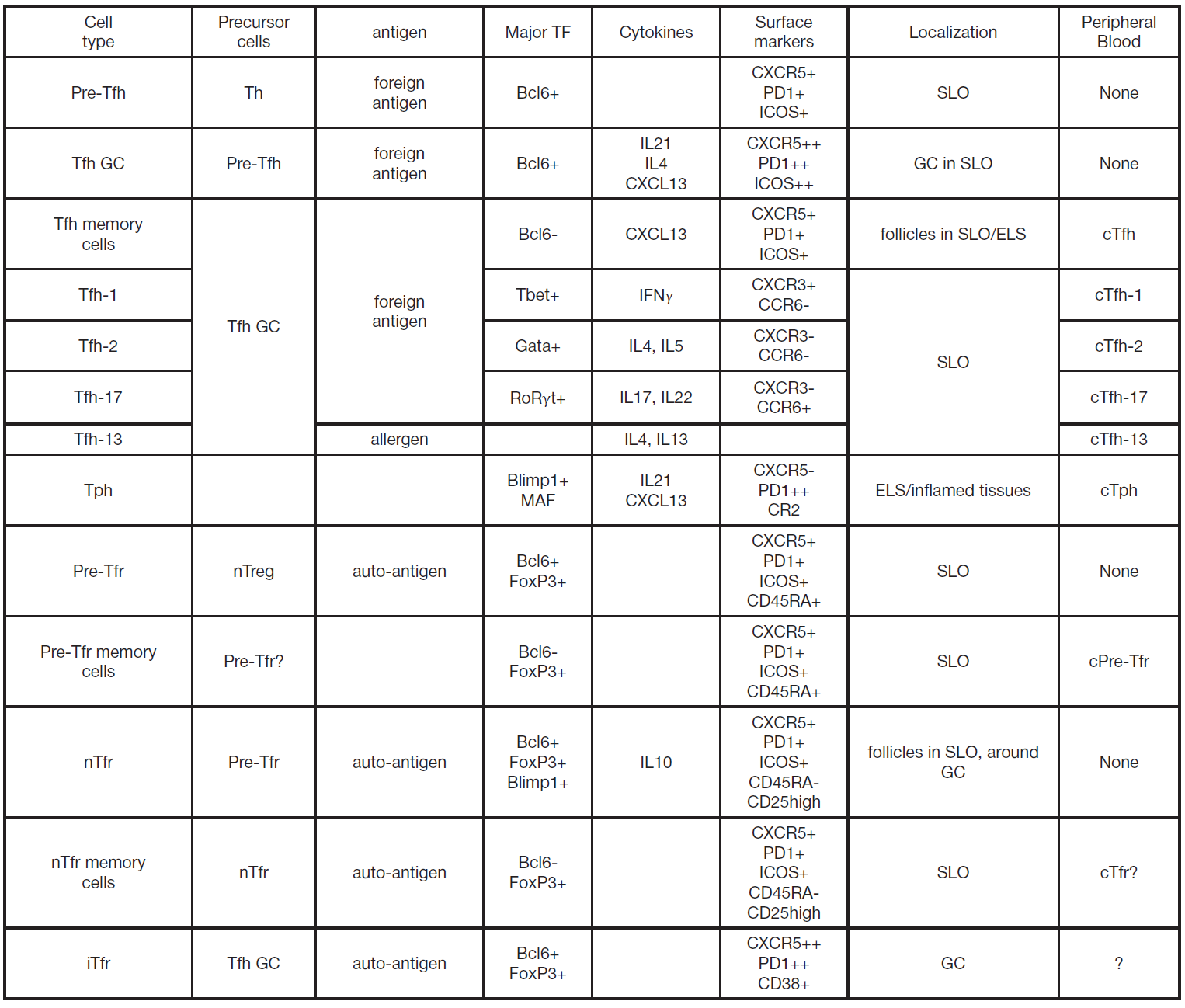
Table 1. Major types of follicular and follicular-like T cells that regulate B cell responses.
Note: GC — germinal centers, TF — transcription factors, SLO — secondary lymphoid organs, ELS — ectopic lymphoid structures.