Copyright: © 2024 by the authors. Licensee: Pirogov University.
This article is an open access article distributed under the terms and conditions of the Creative Commons Attribution license (CC BY).

ORIGINAL RESEARCH

Information capacity of the NF-κB and AP-1 signaling activation sensors in in vitro assessment of dermatotoxic effects

Tolstova TV , Pureczcky VK , Kozhin PM , Luzgina NG , Rusanov AL
About authors

Institute of Biomedical Chemistry, Moscow, Russia

Correspondence should be addressed: Tatiana V. Tolstova
Pogodinskaya, 10, s. 8, Moscow, 119121, Russia; ur.ksm.cmbi@avotslot

About paper

Funding: the study was performed as part of the Programme for Fundamental Scientific Research in the Russian Federation for the long-term period (2021–2030) (№ 122022800481-0).

Author contribution: Tolstova TV — experimental procedure, data acquisition, analysis, and interpretation, manuscript writing, illustrations; Pureczcky VK — experimental procedure, illustrations; Kozhin PM — literature review, manuscript writing, illustrations; Luzgina NG — study concept and design, manuscript writing; Rusanov AL — study planning, manuscript writing, overall guidance for the study.
Received: 2023-12-11 Accepted: 2024-02-16 Published online: 2024-02-27
|
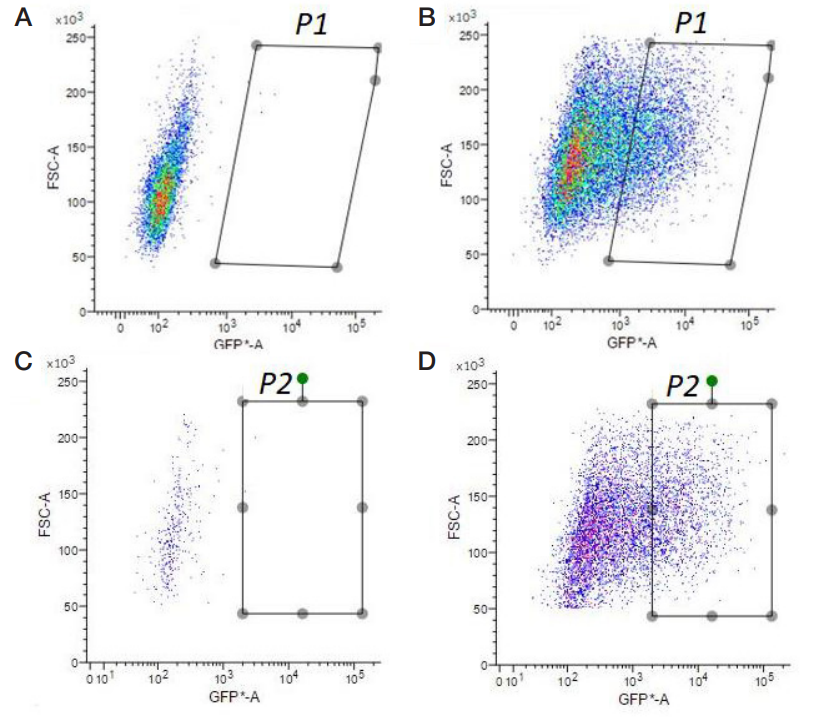
Fig. 1. Fluorescence intensity of transduced cells: control cells (А, C) and transduced cells showing high fluorescence intensity (B, D) in response to stimulation with 20 ng/mL TNFα for HaCaT/NF-κB (gate Р1) and 10 µМ Cd(NO3)2 for HaCaT/AP-1 (gate Р2) throughout 24 h
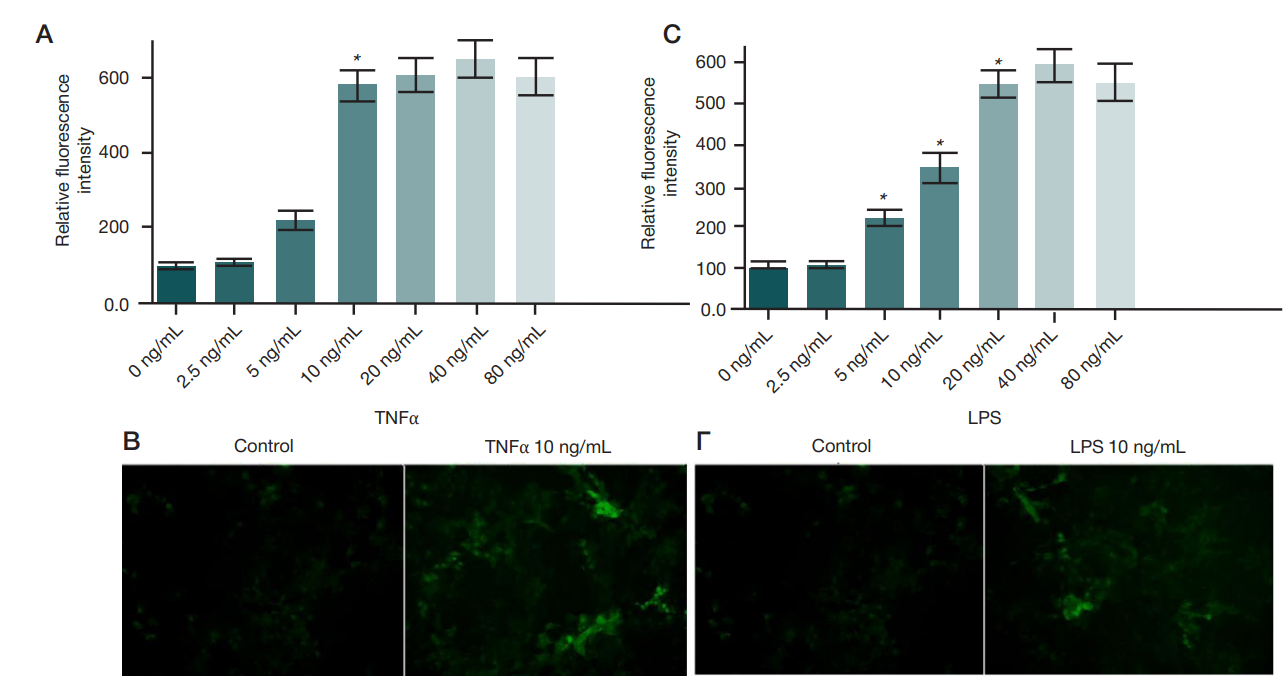
Fig. 2. Changes in the HaCaT/NF-κB cells’ relative fluorescence intensity under exposure to TNFα (А, B) and LPS (C, D). Fluorometry results (А, C) and fluorescence microscopy (B, D). * — significant differences from the previously reported concentration, p < 0.05.
Fig. 3. Assessing activation of the genes encoding the NF-κB transcription factor subunits. Relative expression of RelA and NFKB1 mRNA under exposure to TNFα (А, B) and LPS (C, D). * — significant differences from the control group, p < 0.05
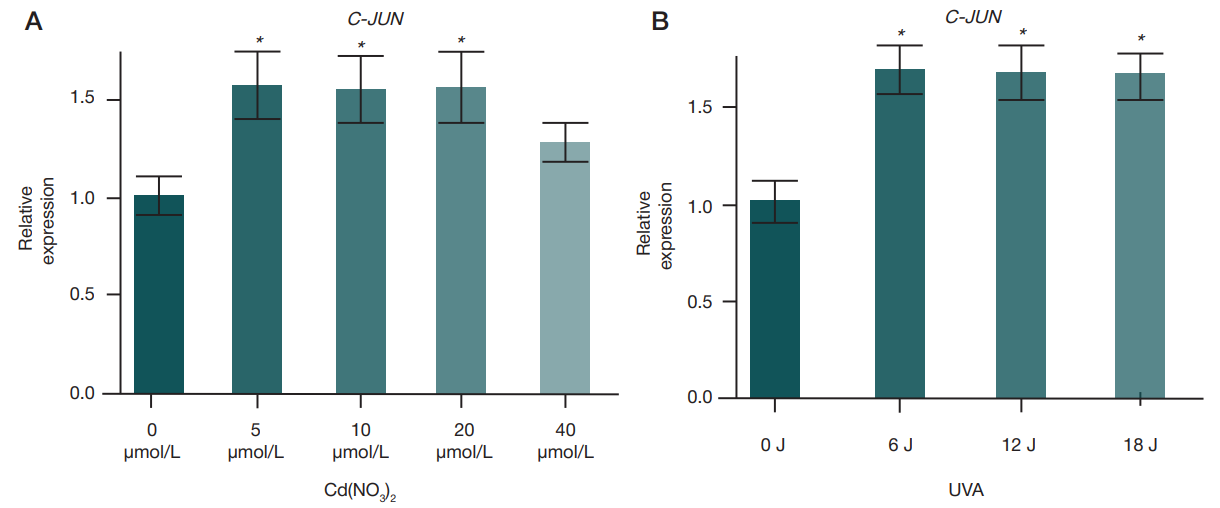
Fig. 4. Assessing activation of the gene encoding the AP-1 transcription factor subunit. Relative expression of the C-JUN mRNA under exposure to Cd(NO3)2 (А) and UVA (B). * — significant differences from the control group, p < 0.05
Table 1. Sequences of PCR primers
Table 2. Changes in the HaCaT/AP-1 cell fluorescence associated with exposure to Cd(NO3)2
Note: * — significant differences from the control group, p < 0.05