Copyright: © 2025 by the authors. Licensee: Pirogov University.
This article is an open access article distributed under the terms and conditions of the Creative Commons Attribution license (CC BY).

ORIGINAL RESEARCH

HMGB1 and anti-HMGB1 antibodies in systemic lupus erythematosus and other rheumatic diseases

Melamud MM1 , Ermakov EA1,2 , Tolmacheva AS1 , Sizikov AE1,3 , Klyaus NA4 , Nevinsky GA1 , Buneva VN1,2
About authors

1 Institute of Chemical Biology and Fundamental Medicine SB RAS, Novosibirsk, Russia

2 Novosibirsk National Research State University, Novosibirsk, Russia

3 Research Institute of Fundamental and Clinical Immunology, Novosibirsk, Russia

4 Almazov National Medical Research Centre, Saint Petersburg, Russia

Correspondence should be addressed: Valentina N. Buneva
prospekt Akademika Lavrentieva, 8, Novosibirsk, 630090, Russia; ur.oib1@avenub

About paper

Funding: this work was supported by the Russian Science Foundation (Grant No. 23-15-00357).

Author contribution: Melamud MM — data analysis, manuscript writing; Ermakov EA — study design, manuscript writing and editing; Tolmacheva AS — experimental work, data analysis; Sizikov AE, Klyaus NA — material collection and preparation, data analysis; Nevinsky GA, Buneva VN — project supervision, editing. The contributions of Melamud MM and Ermakov EA were equal.

Compliance with ethical standards: The study was approved by the Ethics Committee of the Institute of Chemical Biology and Fundamental Medicine, Siberian Branch of the Russian Academy of Sciences (Protocol No. 3 dated June 19, 2023) and was conducted in accordance with the principles of the Declaration of Helsinki. All study participants provided written informed consent.
Received: 2025-10-29 Accepted: 2025-12-06 Published online: 2025-12-14
|
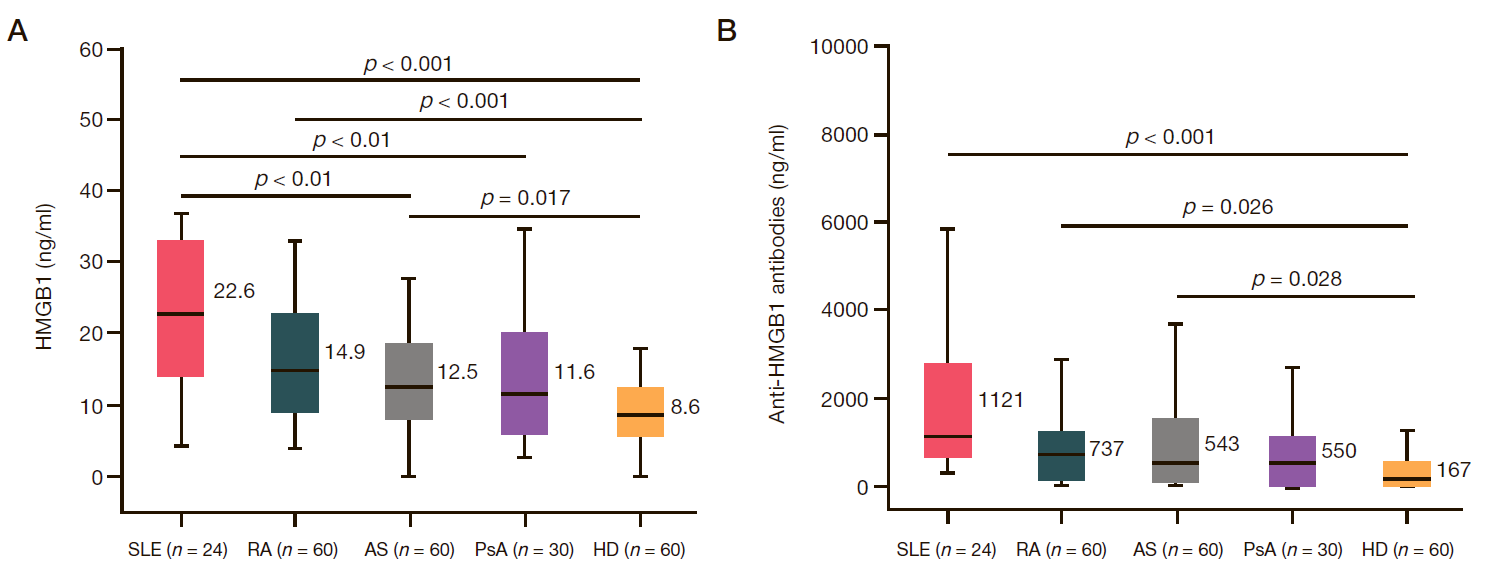
Fig. 1. The blood plasma concentration of HMGB1 (A) and anti-HMGB1 antibodies (B) in patients with systemic lupus erythematosus (SLE), rheumatoid arthritis (RA), ankylosing spondylitis (AS), psoriatic arthritis (PsA) and healthy donors (HD). The analysis was performed using the ANCOVA rank method followed by a post-hoc Dunn’s test, adjusted for age and duration of the disease. The median values are shown to the right of the boxes
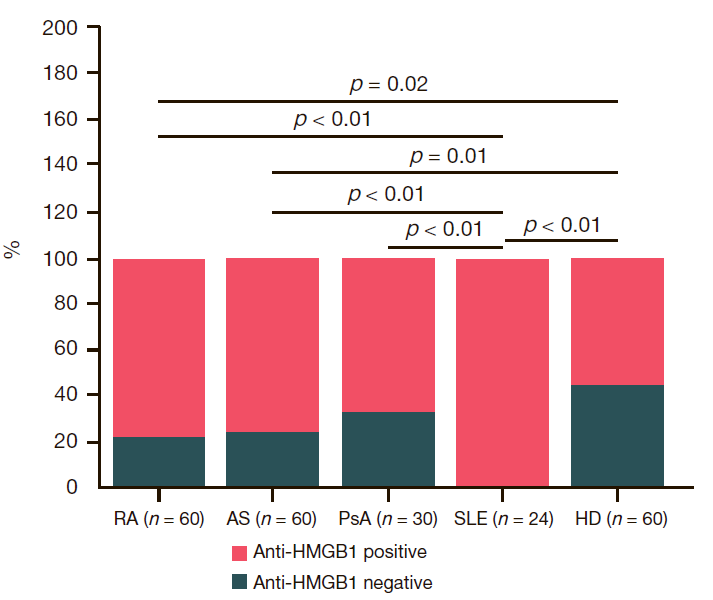
Fig. 2. The frequency of occurrence of anti-HMGB1 antibodies in patients with RA, AS, PsA, SLE, and healthy donors (HD). Statistical significance was assessed using the chi-square test
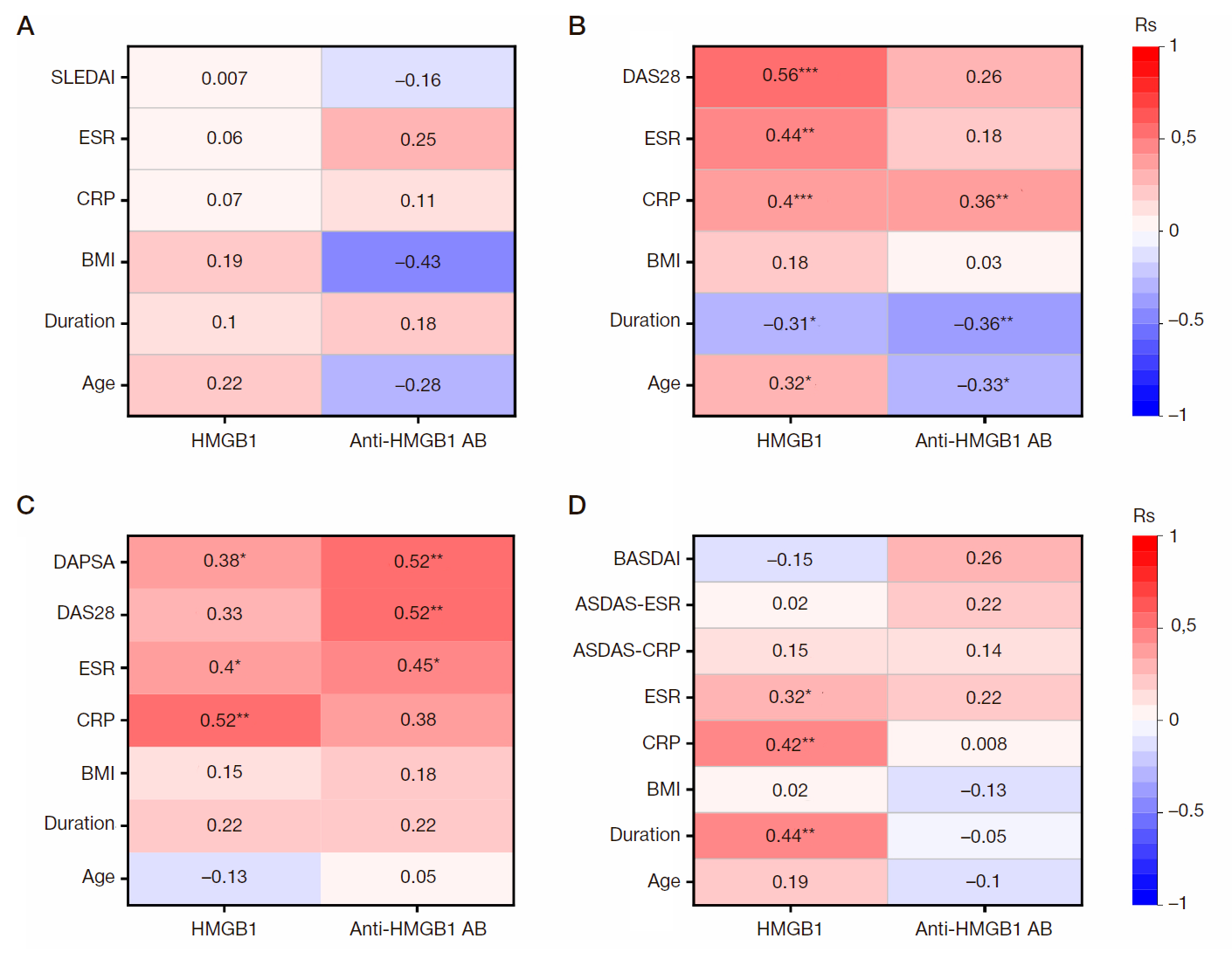
Fig. 3. Correlation of the concentration of HMGB1 and anti-HMGB1 antibodies with the clinical characteristics of SLE (A), RA (B), PsA (C) and AS (D). Spearman's rank correlation coefficients (Rs) are color-coded. * — p < 0.05, * * — p < 0.01, * * * — p < 0.001
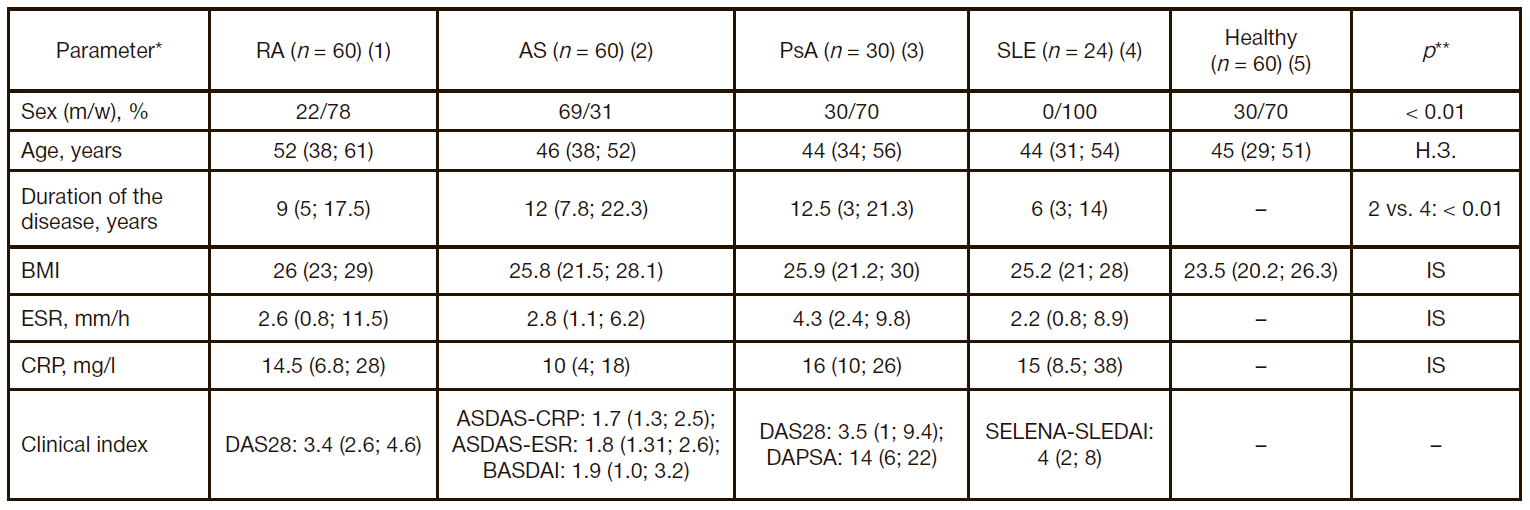
Table 1. Clinical and medical history data of the participants (patients with RDs and healthy individuals)
Note: * — the data are given as Me (Q1; Q3). ** — Yates corrected chi square test, or the Kruskal–Wallis test with Dunn’s post hoc test. BMI — body mass index, ESR — erythrocyte sedimentation rate, CRP — C-reactive protein, IS — insignificant
Table 2. Multiple regression analysis for DAS28 as a dependent variable, and HMGB1 and anti-HMGB1 antibodies as predictors