
Copyright: © 2026 by the authors. Licensee: Pirogov University.
This article is an open access article distributed under the terms and conditions of the Creative Commons Attribution license (CC BY).

ORIGINAL RESEARCH

Role of oxidative protein destruction products in the external genital endometriosis pathogenesis and progression

Osikov MV1,2 , Kurnosenko IV1 , Kryukov VA1,2 , Bivalkevich VA1,2 , Sumerkina VA1
About authors

1 South Ural State Medical University, Chelyabinsk, Russia

2 Chelyabinsk Regional Clinical Hospital, Chelyabinsk, Russia

Correspondence should be addressed: Vladimir А. Kryukov
Ovchinnikova 22, kv. 120, Chelyabinsk, 454011, Russia; ur.kb@29-kihcvov

About paper

Author contribution: Osikov MV, Kurnosenko IV — developing the research idea, concept and design, editing and approving the final version of the manuscript; Kryukov VA — developing the research design, data acquisition and statistical processing, data interpretation, manuscript writing and editing.

Compliance with ethical standards: the study was approved by the Ethics Committee of the South Ural State Medical University (protocol No. 2 dated 05 May 2025). All subjects submitted the informed consent to take part in the study.
Received: 2026-04-01 Accepted: 2026-05-30 Published online: 2026-06-17
|
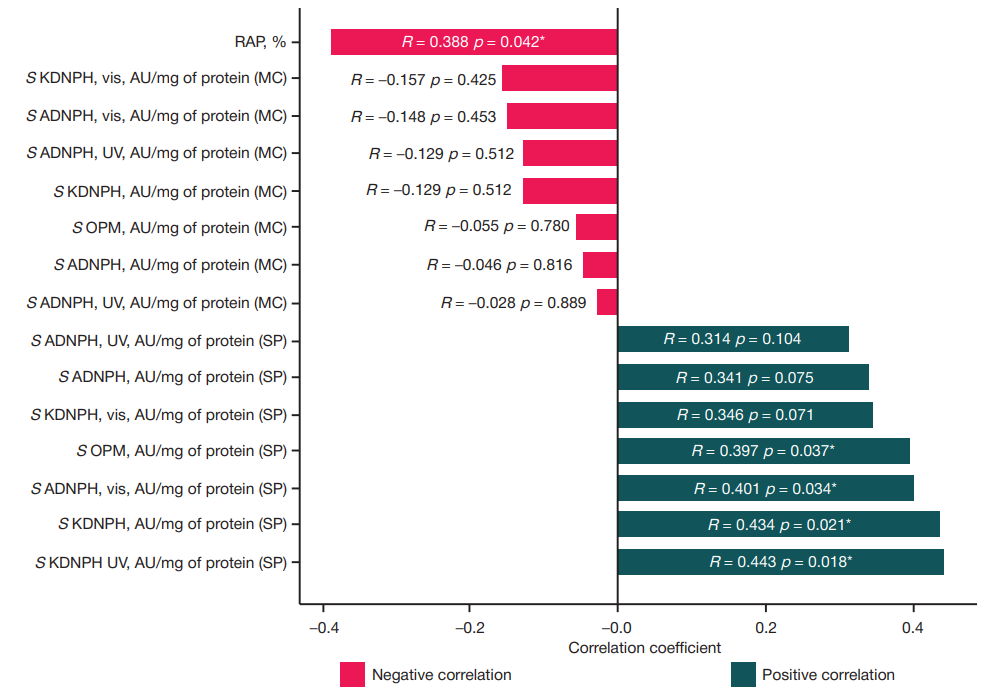
Fig. Correlations between the oxidative protein modification indicators of the ectopic endometrium homogenate and the advanced external genital endometriosis severity according to the AAGL classification. S — total OPM product content; ADNPH — aldehyde-dinitrophenylhydrazones; KDNPH — ketone-dinitrophenylhydrazones; UV — UV range; vis — visible range; AU/mg — OPM product content in optical density units per mass of protein; MC — metal-catalyzed detection mode; SP — spontaneous detection mode; R — Spearman’s rank correlation coefficient; p — significance level; * — significant correlations
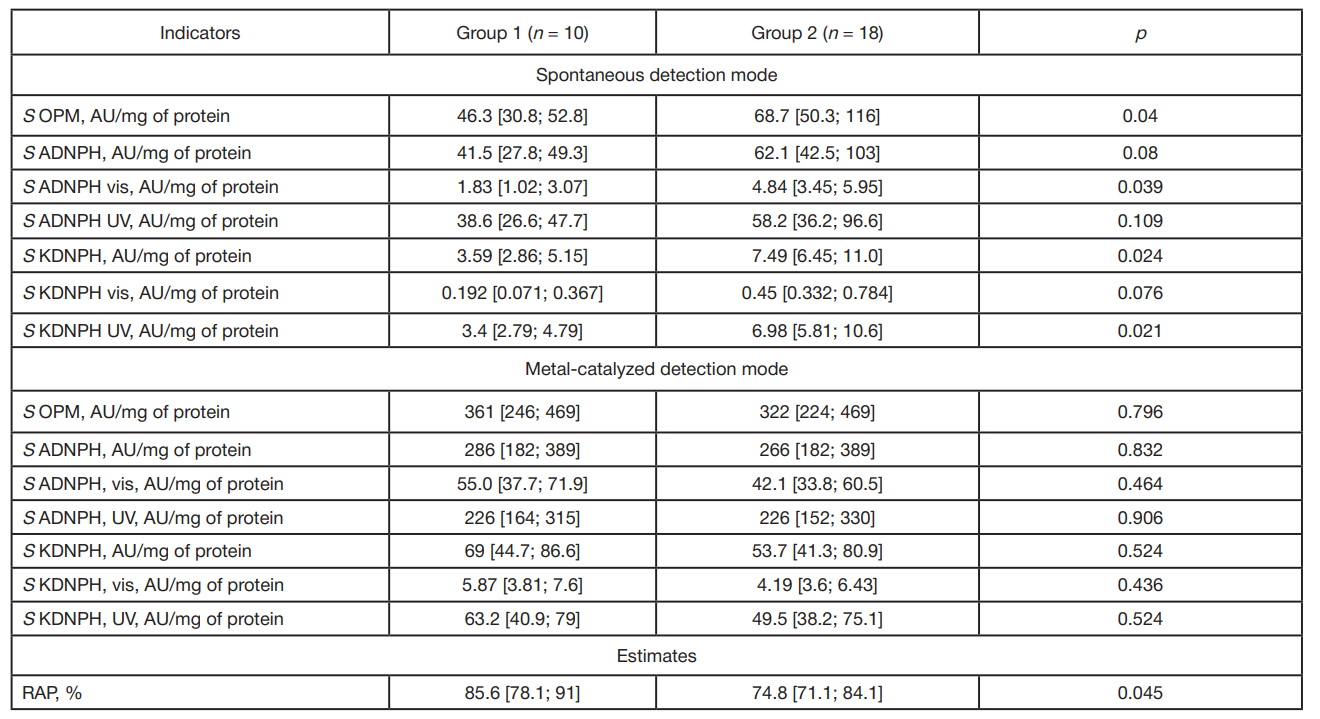
Table. Oxidative protein modification indicators in the ectopic endometrium homogenates of patients with advanced external genital endometriosis
Note: p — significance based on the Mann–Whitney test; S — total OPM product content; ADNPH — aldehyde-dinitrophenylhydrazones; KDNPH — ketone-dinitrophenylhydrazones; UV — UV range; vis — visible range; AU/mg — OPM product content in optical density units per mass of protein.