Copyright: © 2025 by the authors. Licensee: Pirogov University.
This article is an open access article distributed under the terms and conditions of the Creative Commons Attribution license (CC BY).

ORIGINAL RESEARCH

Molecular cytogenetic characterization of a rare recombinant chromosome 22 caused by a maternal intrachromosomal insertion

Yurchenko DA, Markova ZhG, Petukhova MS, Matyushchenko GN, Shilova NV
About authors

Research Centre for Medical Genetics, Moscow, Russia

Correspondence should be addressed: Darya A. Yurchenko
Moskvorechye, 1, Moscow, 115522, Russia; ur.liam@vblahsad

About paper

Funding: this research was supported by the Ministry of Science and Higher Education of the Russian Federation (#FGFF-2023-0003).

Author contribution: Yurchenko DA — study design, development of homemade DNA probes, conducting FISH analysis and interpreting the data, manuscript preparation; Markova ZhG — conducting FISH analysis using commercial DNA probes; Petukhova MS and Matyushchenko GN — clinical genetic counseling of the family; Shilova NV — study conception and design, discussion of results, and scientific editing of the manuscript.

Compliance with ethical standards: the study was approved by the Ethics Commitee of the Research Centre for Medical Genetics (protocol No. 4/2 dated 19 April 2021). The informed consent for participation in the research study was obtained from the patients.
Received: 2025-09-16 Accepted: 2025-10-16 Published online: 2025-10-26
|
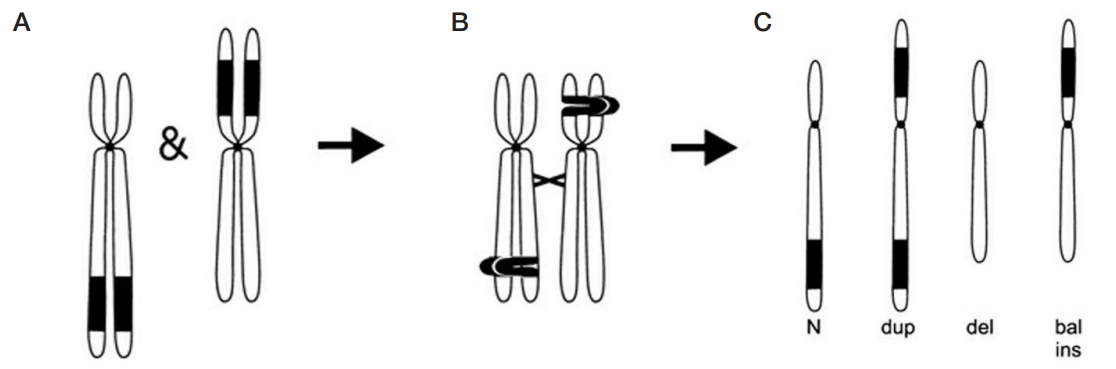
Fig. 1. Gamete production following recombination between the sites of rearrangement in a between-arm intrachromosomal insertion. A. Normal chromosome (left) and chromosome with insertion (right); B. Crossover event; C. Types of gametes. (Adapted from Gardner R. J., Amor D. J., 2018.)
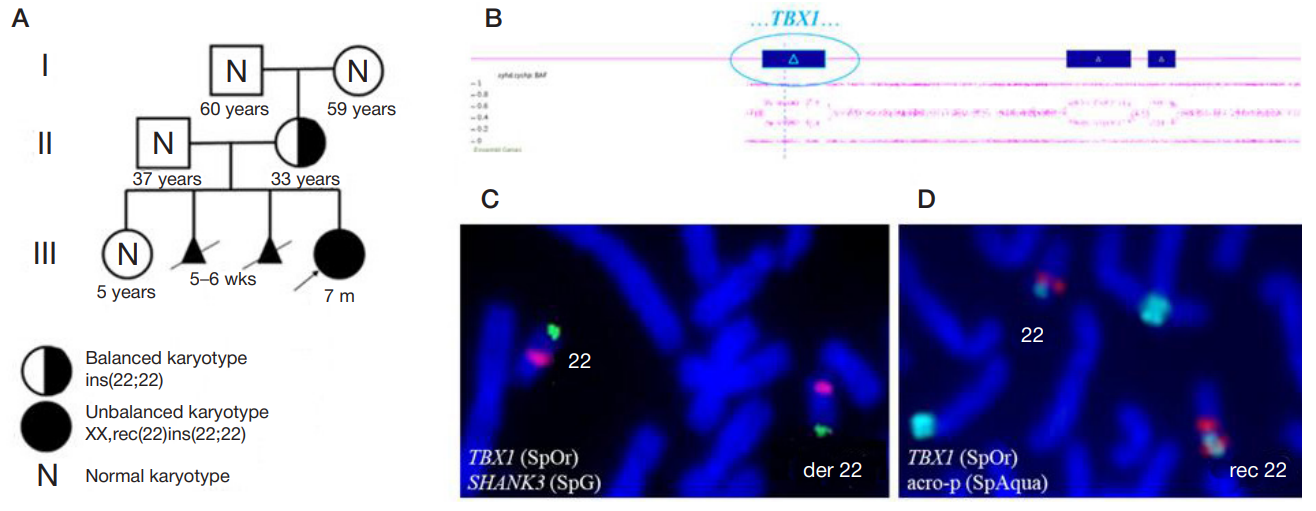
Fig. 2. Familial case of intrachromosomal ins(22;22). А. Three-generation pedigree of the family with the de novo heterozygous carrier of the intrachromosomal insertion on chromosome 22. B. CMA hybridization profile of chromosome 22 demonstrating three duplications in the patient. C. FISH results for the patient’s mother showing hybridization with the DNA probe for the 22q11.2 region (TBX1, SpOrange) and the control probe for SHANK3 (SpGreen), which is not involved in the rearrangement. D. FISH results for the patient showing the recombinant chromosome 22, in which the duplicated fragment containing TBX1 (SpOrange) is inserted into the nucleolar organizer region (p12) (acro-p, SpAqua).
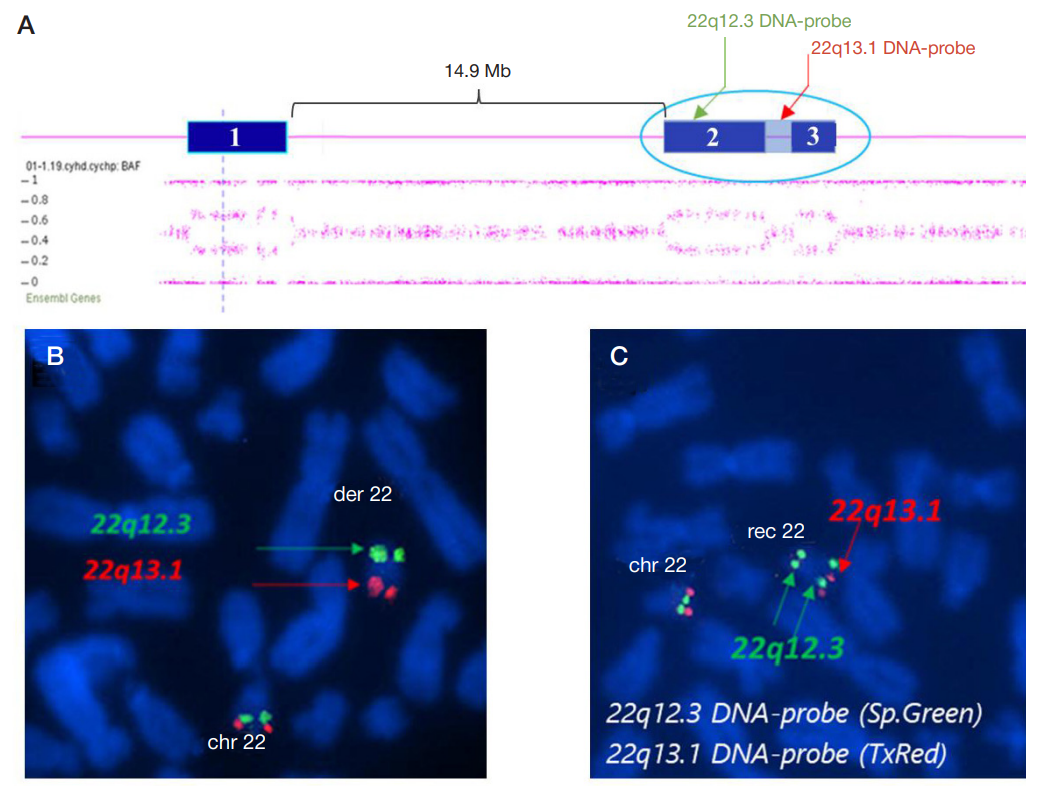
Fig. 3. FISH analysis with homemade DNA probes disproving the hypothesis of a “single” duplication. А. CMA hybridization profile of chromosome 22 in the patient and schematic representation of the genomic localization of the homemade DNA probes designed to test the “single duplication” hypothesis. B. FISH results with homemade DNA probes on maternal metaphase chromosomes, showing that the derivative chromosome 22 resulted from insertion of the 22q12.3 fragment into the nucleolar organizer region (p12). The 22q13.1 region is not involved in the rearrangement. C. FISH results with homemade DNA probes on the patient’s metaphase chromosomes, showing that the recombinant chromosome 22 contains an insertion of the duplicated 22q12.3 fragment into the nucleolar organizer region (p12). The 22q13.1 region is not duplicated and is represented by a single copy on each homologue
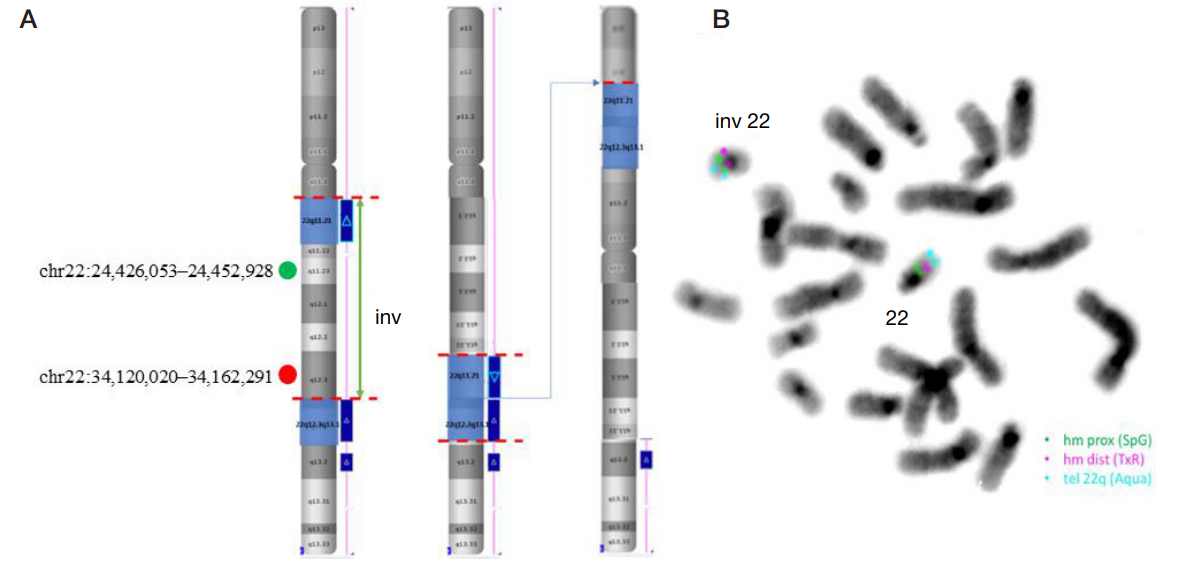
Fig. 4. А. Schematic representation of the mechanism underlying formation of the complex maternal de novo CR. B. Results of FISH analysis using the distal homemade DNA probe (TxRed), the proximal DNA probe (SpGreen) for the inversion region (chr22(hg19):18,037,572–36,793,141) and the commercially available DNA probe for the subtelomeric region of the long arm of chromosome 22 (SpAqua)
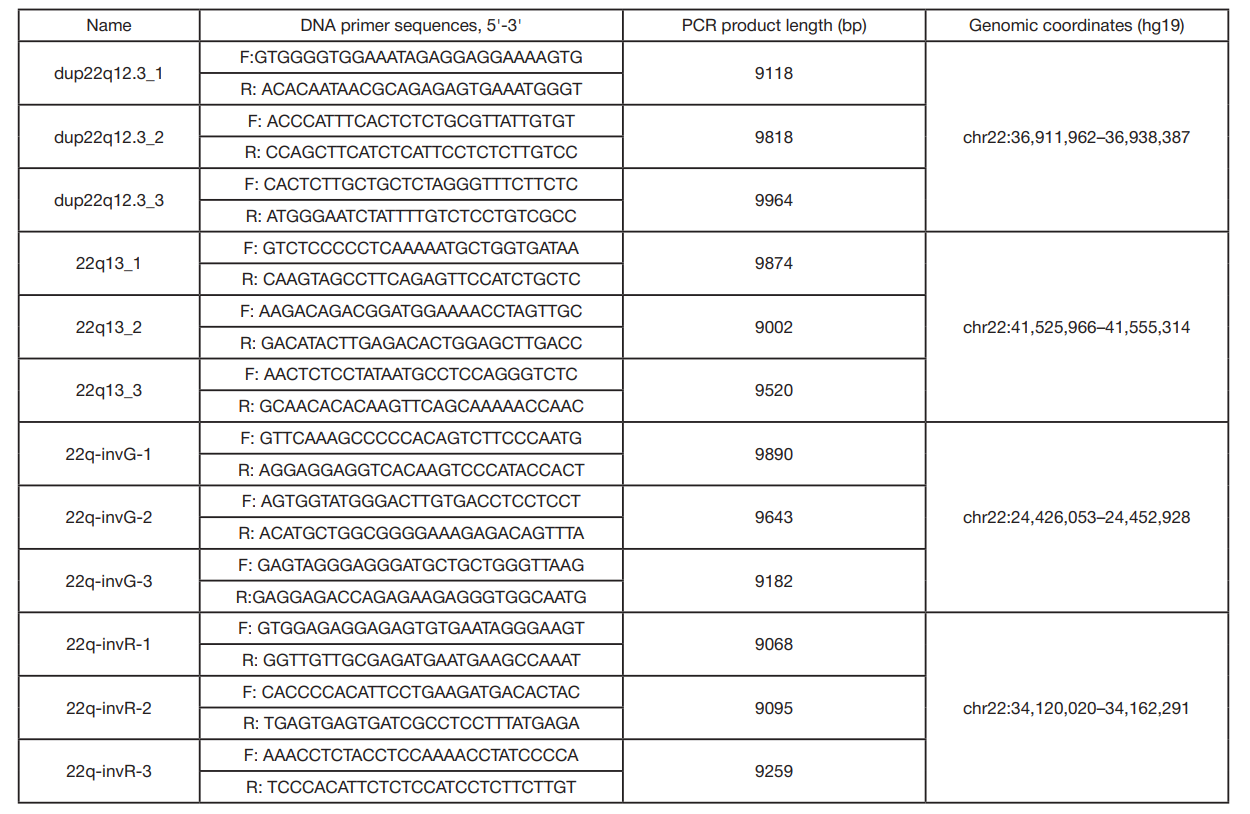
Table. Nucleotide sequences of the primers used in the study