Copyright: © 2025 by the authors. Licensee: Pirogov University.
This article is an open access article distributed under the terms and conditions of the Creative Commons Attribution license (CC BY).

ORIGINAL RESEARCH

Features of the immune response to tumor alloantigens in the context of decreased clonal diversity of T cells

About authors

Blokhin National Medical Research Center of Oncology, Ministry of Health of the Russian Federation, Moscow, Russia

Correspondence should be addressed: Dmitry B. Kazansky
Kashirskoe shosse, 24, str. 15, Moscow, 115478, Russia; ur.xednay@1yksnazak

About paper

Funding: the study was financially supported by the Russian Science Foundation grant No. 22-15-00342-П (https://rscf.ru/project/22-15-00342/).

Author contribution: Korotkova MS — experimental work, analysis of the results; Persiyantseva NA — experimental work, analysis of the results, article editing; Kalinina AA — study planning, analysis and interpretation of the results, analysis of the available literature, article authoring and editing; Khromykh LM — article editing; Kazansky DB — study planning, analysis and interpretation of the results, analysis of the available literature, article editing.

Compliance with ethical standards: the study was approved by the Ethics Committee of the N.N. Blokhin National Research Medical Center of Oncology of the Ministry of Health of the Russian Federation (Minutes No. 3-П10.06.2022 of June 10, 2022) and conducted in strict accordance with the provisions of Directive 2010/63/EU of the European Parliament and of the Council of 22 September 2010 on the protection of animals used for scientific purposes.
Received: 2025-10-06 Accepted: 2025-11-01 Published online: 2025-11-14
|
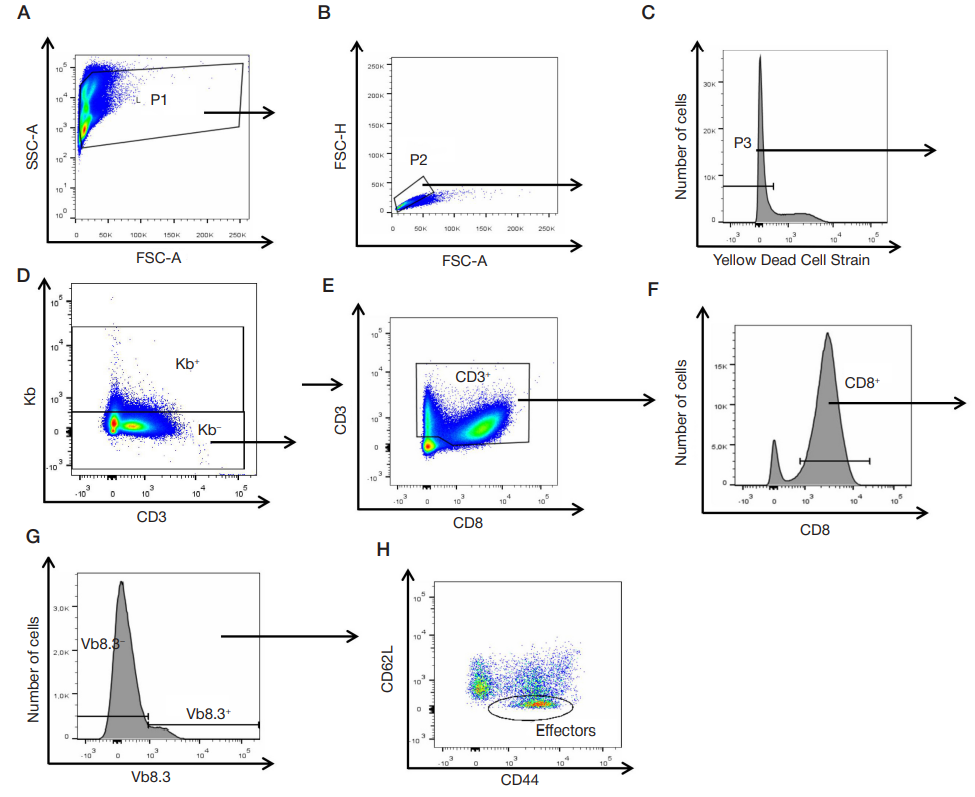
Fig. 1. Analysis of cells in the peritoneal cavity by flow cytometry (strategy). The analysis involved sequential gating of the following populations: leukocytes, gated by forward (FSC-A) and side (SSC-A) light scattering (P1) (A); single cells, gated by FSC-H vs. FSC-A (P2) (B); living cells negative as per yellow dead cell staining (P3) (C); EL-4 cells and recipient leukocytes, gated by co-expression of Kb and CD3 markers: Kb+CD3+ EL-4 cells (Kb+), Kb-CD3+ recipient cells (Kb) (D). E. In a population of KbCD3+ cells (Kb), T-cells (CD3+) were gated by co-expression of CD3 and CD8 (CD3+CD8+ cells). F. Cytotoxic CD8+ T-cells (CD8+) were gated from the CD3+- cell population. G. In the CD8+ T-cell population, cells expressing endogenous β-chains of the T-cell receptor (TCRβ) (Vb8.3) and cells with the transgenic TCRβ (Vb8.3+) were gated. H. For the Vb8.3 and Vb8+ populations of CD8+ T-cells, co-expression of CD44 and CD62L markers was analyzed, and the proportion (%) of effectors (CD62LCD44+) was determined
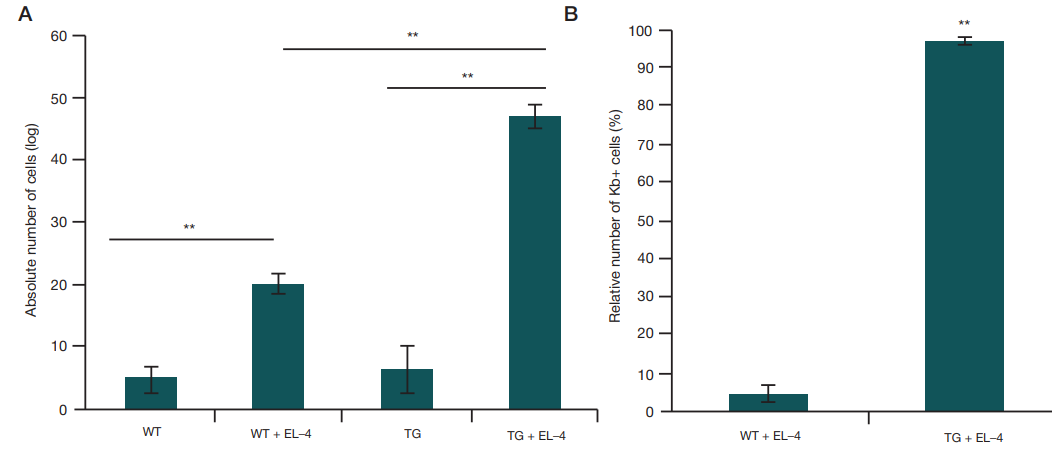
Fig. 2. Features of the development of EL-4 allogeneic lymphoma in 7B transgenic mice. Allogeneic lymphoma EL-4 (H-2Kb) cells were injected intraperitoneally to 7B (H-2k) transgenic mice (TG+EL-4). Non-transgenic siblings (WT+EL-4) were used as controls. On day 12 after EL-4 injection, perinoteal cells were analyzed by flow cytometry. A. The absolute number (log) of cells. * * — p ≤ 0.01 (ANOVA, post-hoc Tukey test). B. The relative number (%) of EL-4 (Kb+) tumor cells. * * — p ≤ 0.01 (Student's unpaired t-test). Data from two independent experiments (n = 46) are presented
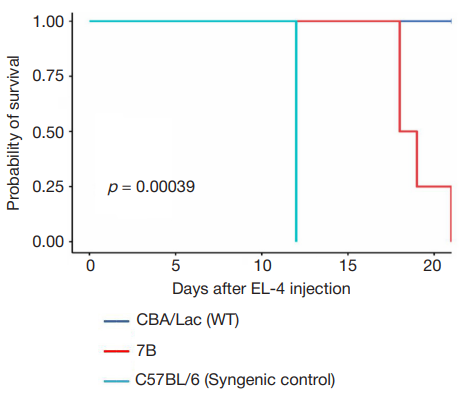
Fig. 3. Survival curves of 7B transgenic mice after EL-4 lymphoma transplantation. Parental CBA/Lac (WT) mice and C57BL/6 mice, for which EL-4 is a syngeneic tumor, were used as controls. The data from one representative experiment (n = 4) are presented
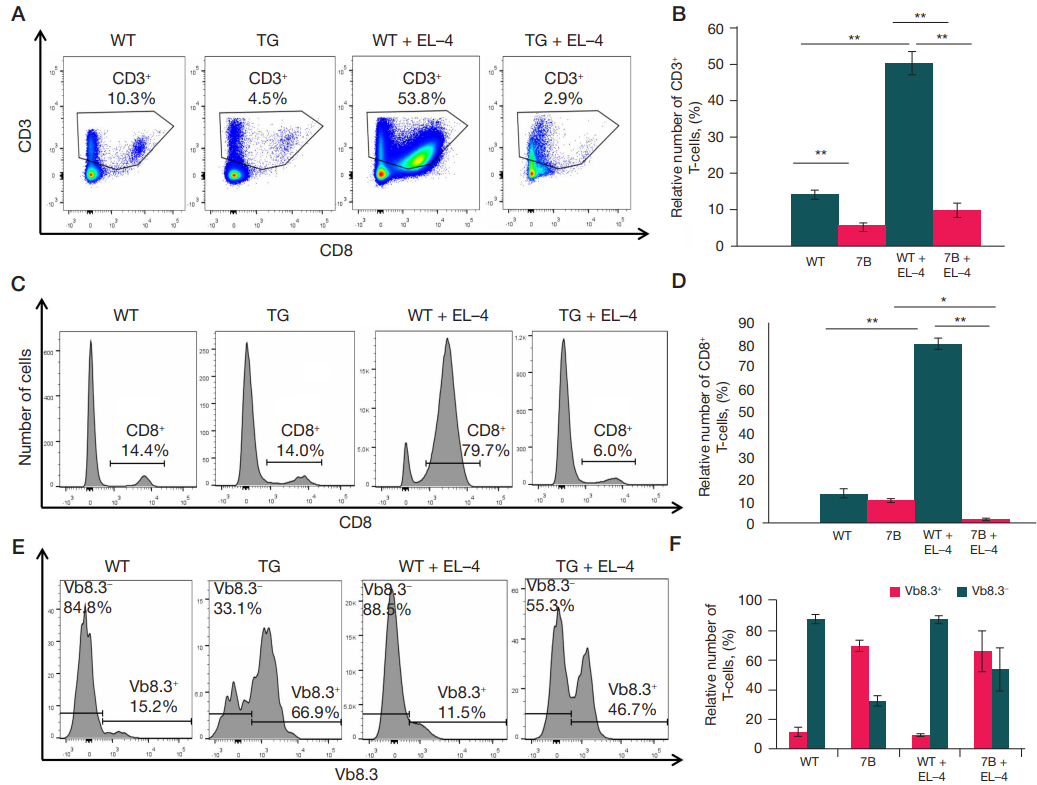
Fig. 4. Analysis of the immune response of 7B mice to an allogeneic tumor in vivo. Transgenic 7B mice (TG+EL-4) and non-transgenic siblings (WT+EL-4) were injected intraperitoneally with EL-4 allogeneic lymphoma cells. On day 12 after EL-4 injection, peritoneal cells were analyzed by flow cytometry. Intact (non-immunized) animals of the CBA/Lac (WT) parent line and the 7B (TG) transgenic line were used as controls. A, B. The relative number (%) of T-cells (CD3+). C, D. The relative number (%) of cytotoxic CD8+ T-cells. E, F. The relative number (%) of CD8+ T-cells with the transgenic β-chain of the T-cell receptor (TCRβ) (Vb8.3+) and CD8+ T-cells with endogenously rearranged TCRβ (Vb8.3). A, C, E. Data from one representative staining are presented. B, D, F. Data from the two experiments are presented as the mean ± standard error of the mean (n = 46). * — p ≤ 0.05; * * — p ≤ 0.01, ANOVA, post-hoc Tukey test
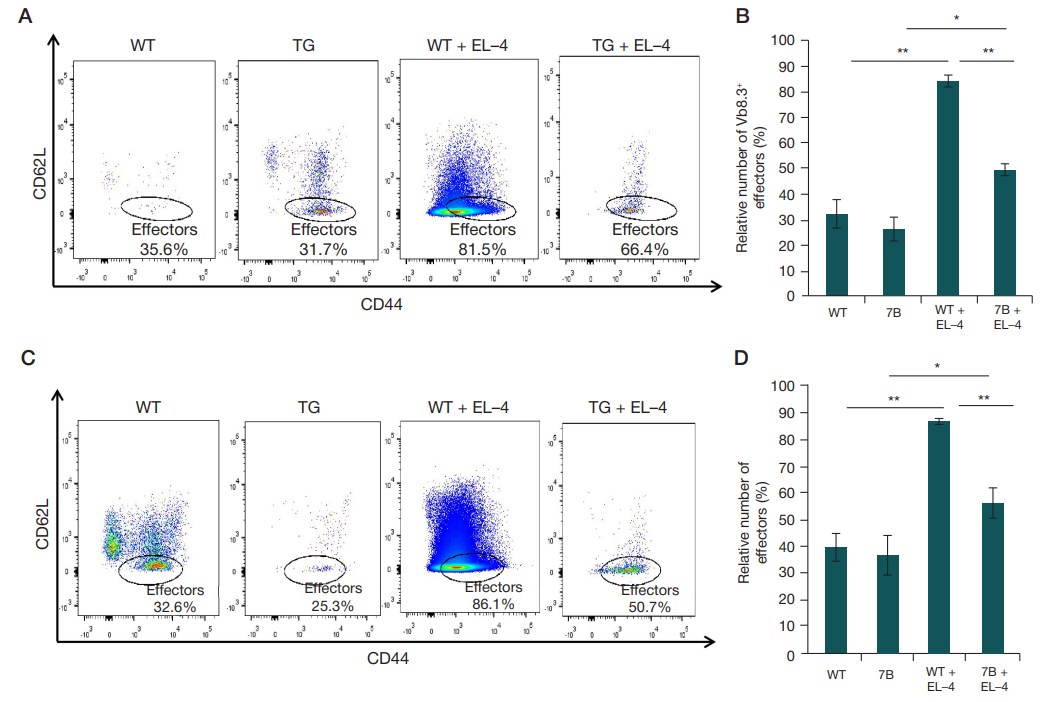
Fig. 5. Analysis of the pool of cytotoxic effector T-cells in 7B transgenic mice in response to EL-4 allogeneic lymphoma in vivo. Analysis of effector CD44+CD62L CD8+ T-cells in the peritoneal cavity of 7B transgenic mice (TG+EL-4) and non-transgenic siblings (WT+EL-4) on day 12 after EL-4 injection. Intact (non-immunized) animals of the CBA/Lac (WT) parent line and the 7B (TG) transgenic line were used as controls. A, B. The relative number (%) of effector T-cells with transgenic TCRß (Vb8.3+). C, D. The relative number (%) of effector T-cells with endogenously rearranged TCRß (Vb8.3). A, C. Data from one representative staining are presented. B, D. Data from the two experiments are presented as the mean ± standard error of the mean (n = 46). * — p ≤ 0.05; * * — p ≤ 0.01, ANOVA, post-hoc Tukey test