Copyright: © 2026 by the authors. Licensee: Pirogov University.
This article is an open access article distributed under the terms and conditions of the Creative Commons Attribution license (CC BY).

ORIGINAL RESEARCH

Construction and characterization of the attenuated recombinant influenza virus strains expressing human interleukin 1β

Romanovskaya-Romanko EA , Ozhereleva OO , Plotnikova MA , Altuhov AS , Stukova MA
About authors

Smorodintsev Research Institute of Influenza, St. Petersburg, Russia

Correspondence should be addressed: Ekaterina A. Romanovskaya-Romanko
Professora Popova, 15/17, St. Petersburg, 197022, Russia; ur.xednay@akmormor

About paper

Funding: the study was supported by the Russian Science Foundation (project No. 25-25-00939).

Author contribution: Romanovskaya-Romanko EA — concept, testing, material processing, manuscript writing; Ozhereleva OO — literature review, constructing plasmids, testing, statistical data processing; Plotnikova MA — testing, statistical data processing; Altuhov AS — testing; Stukova MA — approval of the final version of the article.

Compliance with ethical standards: the study was approved by the Ethics Committee of the Smorodintsev Research Institute of Influenza of the Ministry of Health of the Russian Federation (protocol No. 07 dated April 23, 2026). Animals were kept under standard conditions in accordance with the Directive 2010/63/ЕС, federal guidelines, and the institutional policy of the Smorodintsev Research Institute of Influenza of the Ministry of Health of the Russian Federation.
Received: 2026-07-02 Accepted: 2026-07-28 Published online: 2026-08-17
|
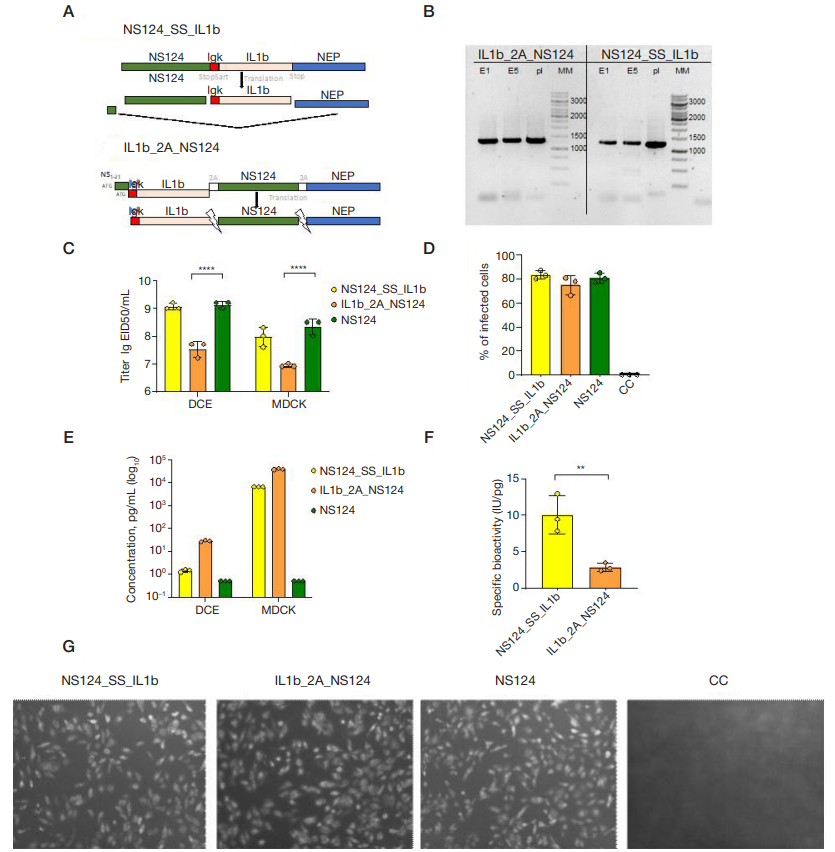
Fig. 1. Construction and characterization of the recombinant influenza A viruses expressing IL1β. А. Schemes of genomic constructs of the chimeric genome segment NS of recombinant viruses IL1b_2A_NS124 and NS124_SS_IL1b. B. Electropherogram of the recombinant strains’ genome segment NS amplification products. МM — molecular weight marker; Е1 — first embryo passage; Е5 — fifth embryo passage; pl — control plasmid. C. Reproductive properties of recombinant viral strains in the 10-day DCE system and the MDCK cell culture. Here we present the results of infectious activity assessment for the fifth embryo passage, the mean titer log10 EID50 (TCID50) ± SD. D. Effectiveness of the А549 cell infection with recombinant viral strains. Here we present the mean percentage of infected cells for three replicates ± SD. E. IL1β quantification in the allantoic fluid and the cellular supernatant of the MDCK cells infected with recombinant strains by ELISA. F. IL1β specific bioactivity. Estimated quantity of the IL1β bioactive form dtemined in the proliferation test using the HEK-Blue IL1β reporter system recalculated for 1 pg of IL1β detected by ELISA. G. Representative images of the A549 obtained by fluorescence microscopy. The results of staining the NS1 protein detected using Alexa Fluor 488(488/509 nm) are highlighted in gray. 40× magnification
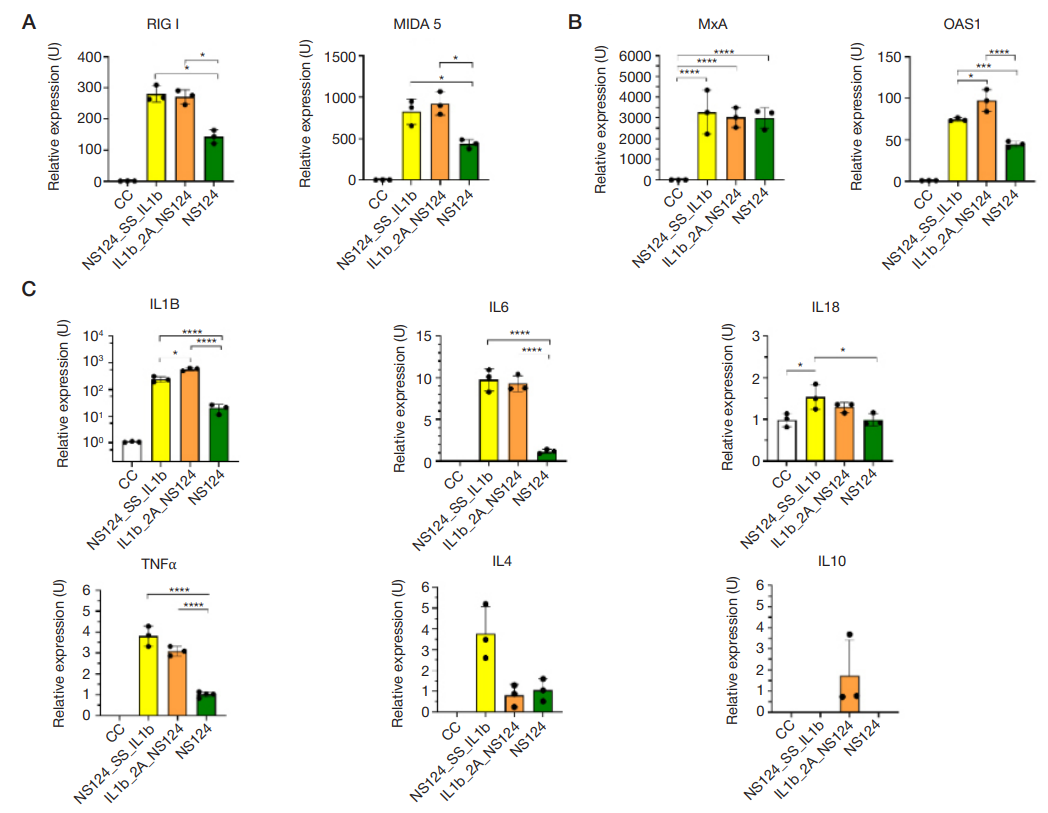
Fig. 2. Activation of the expression of intracellular sensors (А), antiviral proteins (B), and cytokines (C) in the А549 cells in response to infection with the recombinant influenza virus strains expressing IL1β. The relative expression of messenger RNA (mRNA) is presented as mean values for three biological replicates (bars) and individual values for each measurement (point). One-way analysis of variance (ANOVA) was used to assess significance of differences in the normalized ΔCt values, and Tukey’s test was used for multiple comparisons (* — p < 0.05; * * — p < 0.01; * * * — p < 0.001; * * * * — p < 0.0001)
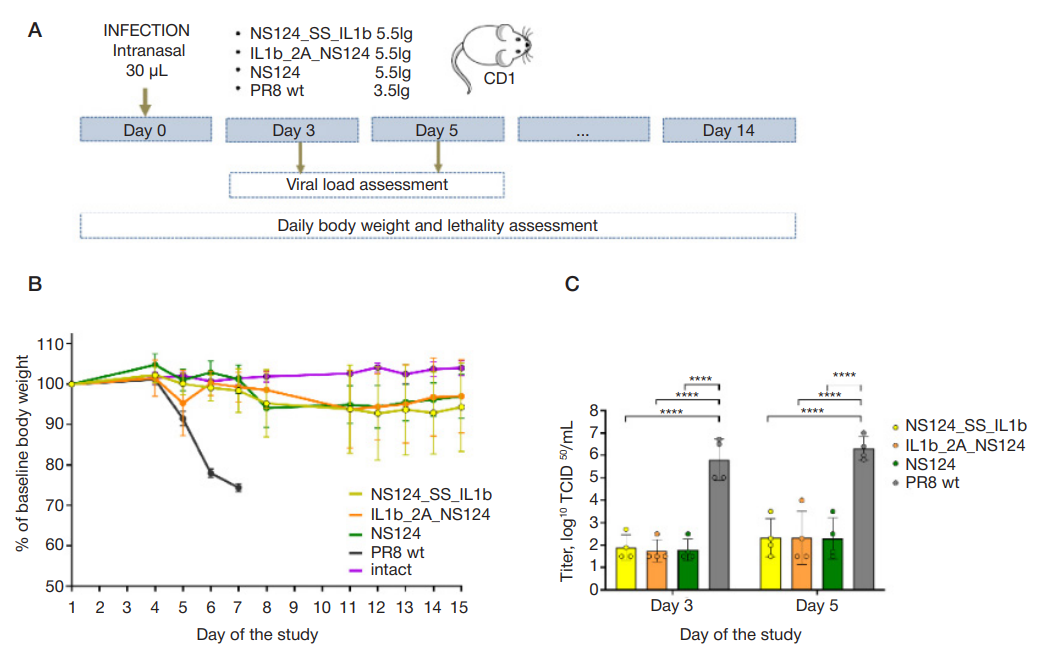
Fig. 3. Assessment of safety of the recombinant influenza strains expressing IL1β that were intranasally administered to mice. А. Experimental design. B. Dynamic changes in the animals’ body weight (n = 5 per group) after the intranasal administration of recombinant viruses. C. Evaluation of viral load in the lung tissues of mice on days 3 and 5 after the intranasal administration of recombinant viral strains expressing IL1β. Bars represent the mean indicator value for the group (n = 4) ± SD, points represent individual indicator values for each animal. Two-way analysis of variance was used to assess significance of differences in the average group values, and the Dunnett's test was used for multiple comparisons with the control group PR8 wt (* * * * — p < 0.0001)