Copyright: © 2026 by the authors. Licensee: Pirogov University.
This article is an open access article distributed under the terms and conditions of the Creative Commons Attribution license (CC BY).

ORIGINAL RESEARCH

Sensorimotor rhythm desynchronization during execution of quasi-movements based on natural finger movements

Svirin EP1 , Berdyshev DA1,2 , Shishkin SL2
About authors

1 Neurocognitive Research Center (MEG Center), Moscow State University of Psychology and Education, Moscow, Russia

2 Lomonosov Moscow State University, Moscow, Russia

Correspondence should be addressed: Evgeny P. Svirin
Shelepihinskaya naberezhnaya, 2А, str. 2, Moscow, 123290, Russia; moc.liamg@tnikigoj

About paper

Funding: the study was supported by the Russian Science Foundation grant No. 24-75-00105, https://rscf.ru/project/24-75-00105/.

Acknowledgements: the authors would like to thank A. Vasilyev for guidance on data processing and feedback.

Author contribution: Svirin EP — study design, experimental procedure, analysis of results, manuscript writing, writing the final version; Berdyshev DA — study design, analysis of results, manuscript writing; Shishkin SL — study conceptualization, discussion, writing the final version.

Compliance with ethical standards: the study was approved by the Ethics Committee of the Moscow State University of Psychology & Education (protocol No. 4 dated 01 April 2026). All subjects submitted the informed consent to take part in the study.
Received: 2026-04-19 Accepted: 2026-05-11 Published online: 2026-06-14
|
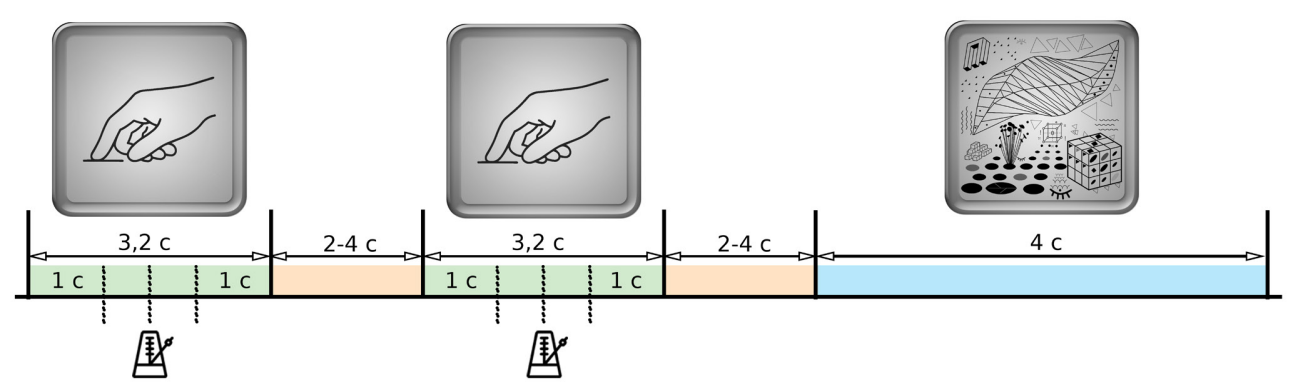
Fig. 1. Stimulus presentation block structure. Each block consisted of two 3.2 s motor sequences (green), in each of which three sound signals were presented with an interval of 600 ms (vertical dotted lines). At the end of the block, a visual task was presented for 4 s (blue); the intervals between motor sequences and the visual task (yellow) varied randomly from 2 to 4 s. Images (above) are given as an example of stimuli displayed on the screen
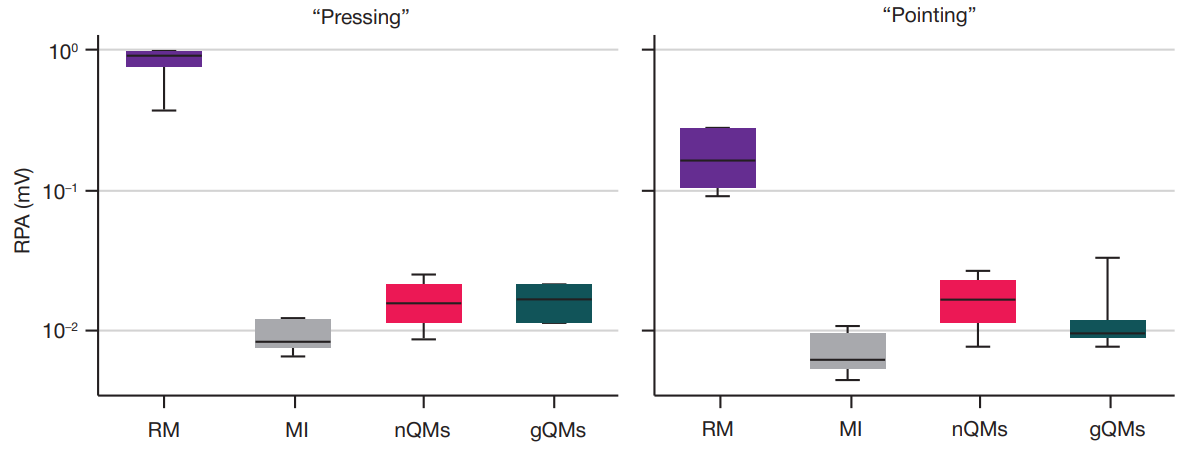
Fig. 2. Robust peak amplitude (RPA) of the strain gauge signal for various movement types and actions. Box plots show median values and interquartile ranges, whiskers — range from minimum to maximum. Ordinate axis — log scale. RM — real movement, MI — motor imagery, nQMs — non-goal-directed quasi-movements, gQMs — goal-directed quasi-movements
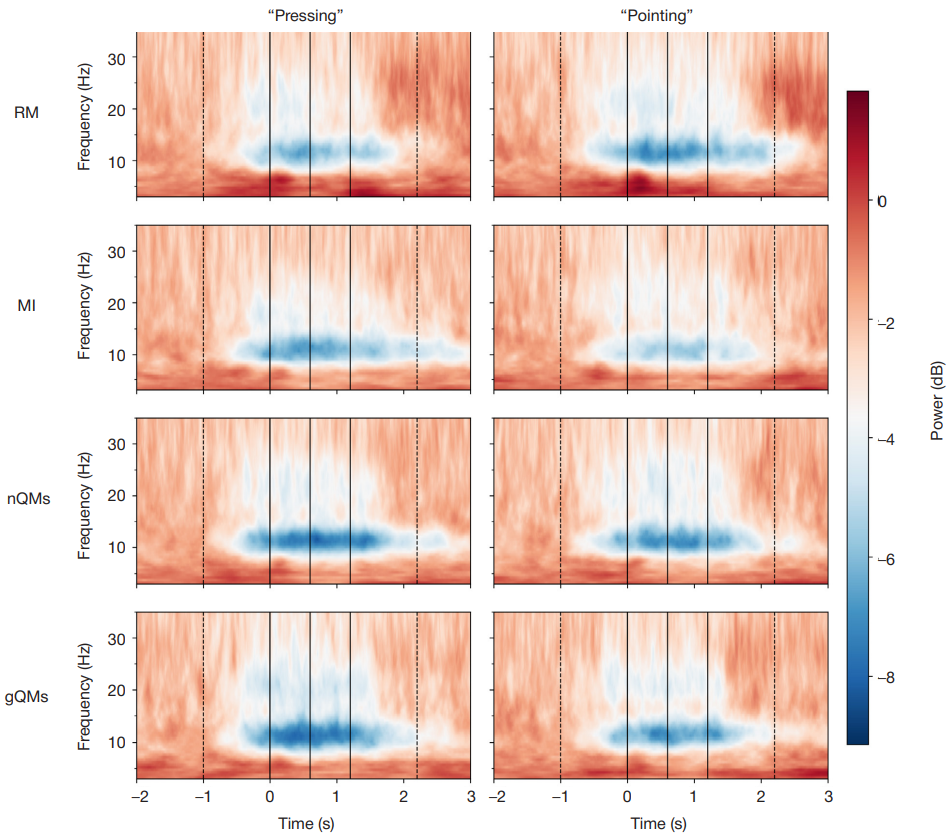
Fig. 3. Average group time-frequency spectrograms of EEG power (Morlet wavelet transform) in the contralateral sensorimotor region of interest for various actions and movement types. Power is normalized to the baseline level in dB; blue color corresponds to desynchronization, red — synchronization. Vertical dotted lines show the time range of visual stimulus presentation. Vertical solid lines correspond to the time of presenting three sound signals. RM — real movement, MI — motor imagery, nQMs — non-goal-directed quasi-movements, gQMs — goal-directed quasi-movements
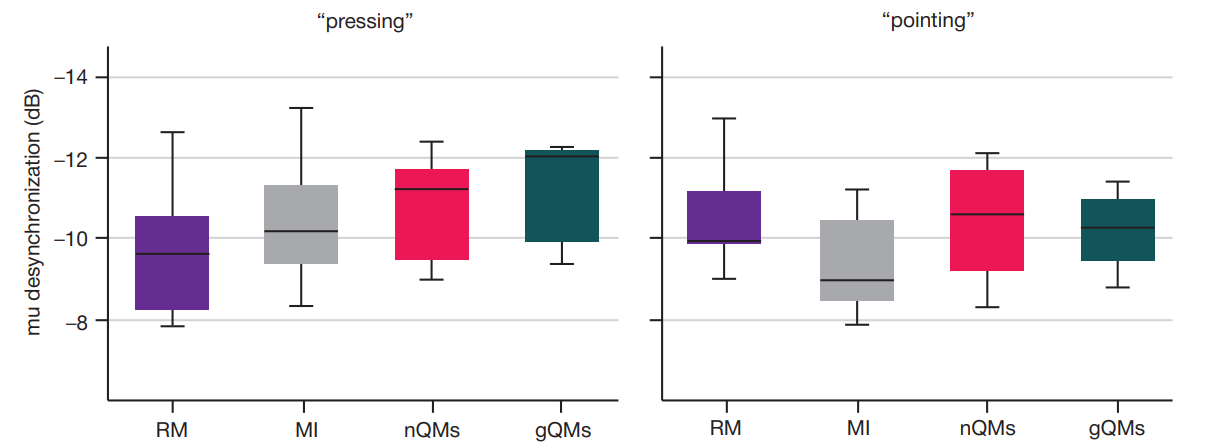
Fig. 4. Contralateral mu ERD (8–13 Hz) for various actions and movement types. More negative values correspond to stronger ERD. Box plots show median values and interquartile ranges by subjects; whiskers — range from minimum to maximum. RM — real movement, MI — motor imagery, nQMs — non-goal-directed quasi-movements, gQMs — goal-directed quasi-movements
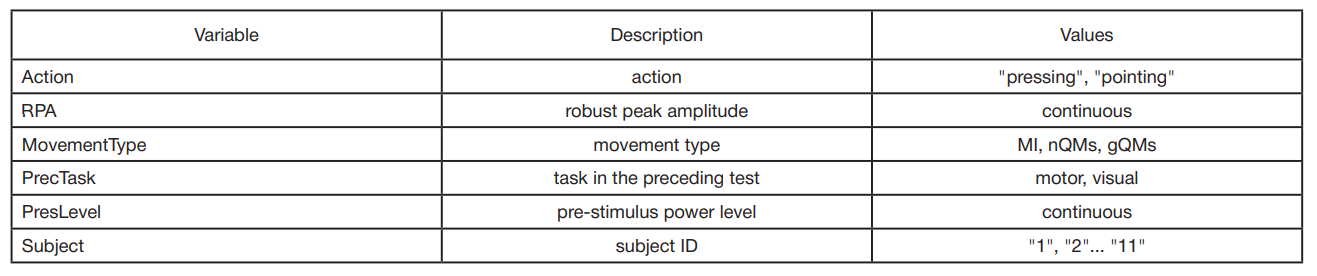
Table 1. Independent variables used in linear mixed effects models. MI — motor imagery, nQMs — non-goal-directed quasi-movements, gQMs — goal-directed quasi-movements
Table 2. Average group proportion of epochs with the increased residual movement under the QM conditions: nQMs — non-goal-directed quasi-movements, gQMs — goal-directed quasi-movements
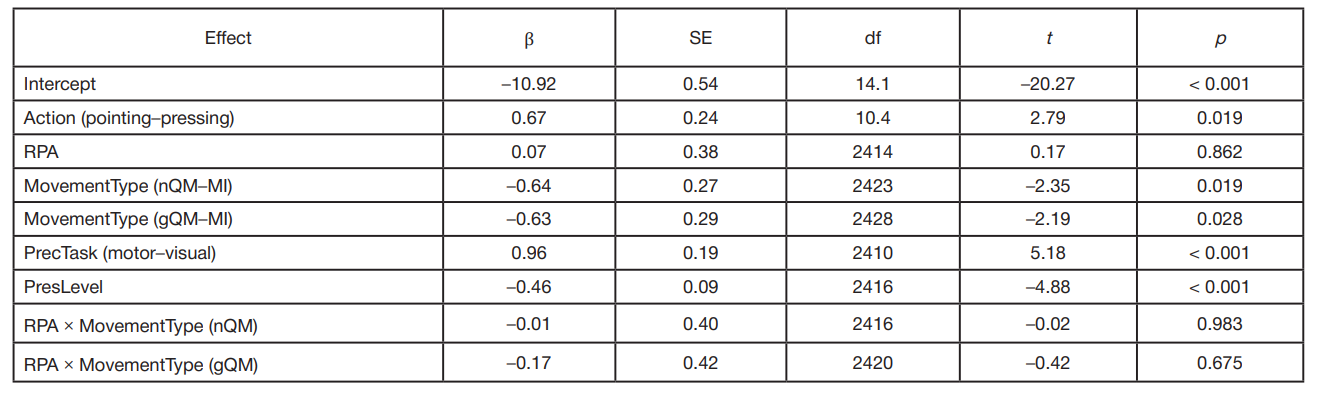
Table 3. Full inference of the mixed effects model (1) for the contralateral mu ERD. The table provides coefficients of the model fixed effects; p-values for post-hoc comparisons with Tukey adjustment are provided in the text